


ENGR.ECONOMIC ANALYSIS
14th Edition
ISBN: 9780190931919
Author: NEWNAN
Publisher: Oxford University Press
expand_more
expand_more
format_list_bulleted

Related questions

Concept explainers
Question
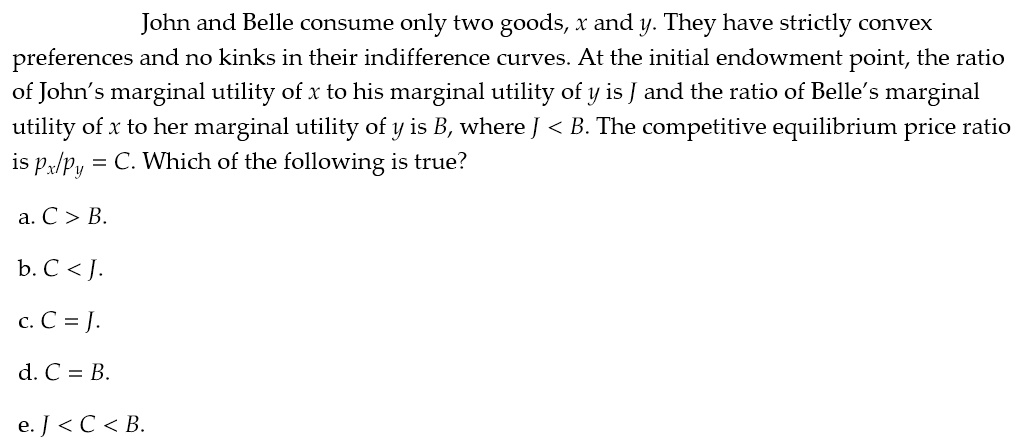

Transcribed Image Text:John and Belle consume only two goods, x and y. They have strictly convex
preferences and no kinks in their indifference curves. At the initial endowment point, the ratio
of John's marginal utility of x to his marginal utility of y is J and the ratio of Belle's marginal
utility of x to her marginal utility of y is B, where J < B. The competitive equilibrium price ratio
is px/py = C. Which of the following is true?
a. C> B.
b. C < J.
c. C = J.
d. C = B.
e. J <C<B.
Expert Solution

This question has been solved!
Explore an expertly crafted, step-by-step solution for a thorough understanding of key concepts.

Step by stepSolved in 3 steps

Knowledge Booster

Learn more about
Need a deep-dive on the concept behind this application? Look no further. Learn more about this topic, economics and related others by exploring similar questions and additional content below.Similar questions
- Graph make grapharrow_forwardI need help with this homework question.arrow_forward4. Aaron and Burris have the following utility functions over two goods, x and y. Aaron’s utility function: UA(xA, yA) = min{xA/3, yA} Burris’s utility function: UB(xB, yB) = 9xB + 3yB Aaron’s endowment is eA = (2, 4). Burris’ endowment is eB = (10, 8). In an Edgeworth Box diagram, show which allocations are in the core. Solve for the set of Pareto optimal allocations (i.e. the contract curve) in the Edgeworth Box. Illustrate the contract curve in an Edgeworth Box diagram. Let good y be the numeraire (i.e. set py = 1 and let px = p). Solve for the Walrasian competitive equilibrium allocation and price ratio.arrow_forward
- Consider a market with two households (A and B) and two goods (X and Y). Each household holds 12 units of each good. Household A has a utility UA = 5 In LA + In yA when it consumes bundle (*A, YA). Household B hasa utility UB = In aB+5 Inyg when it consumes bundle (гв, ув). The market reaches an equilibrium when the price of each good is $1. Which, of the following sentences, correctly explains what happens in the market? Household A purchases 8 units of good X from household B. Household B purchases 8 units of good Y from household A. Household A purchases 7 units of good Y from household B. Household B purchases 7 units of good X from household A. Household A purchases 9 units of good X from household B. Household B purchases 9 units of good Y from household A. O Household A purchases 7 units of good X from household B. Household B purchases 7 units of good Y from household A. Household A purchases 9 units of good Y from household B. Household B purchases 9 units of good X from…arrow_forwardConsider the pure exchange economy with 2 goods, good 1 and good 2, and two consumers, consumer A and consumer B. The consumers have the following utility functions: UA(X1A,X2A)=X1A+3x2A; UB(X1B,X2B)=x1B +X2B. Consumer A is initially endowed with 4 units of good A and no unit of good 2, that is, consumer A's initial endowment is (W1A,W2A)=(4,0). Consumer B is initially endowed with 3 units of good 2 and no unit of good 1, that is, (WIB,W2B)=(0,3). In order to implement the allocation (x1A,X2A)=(0,1), (x1B,X2B)=(4,2) as a Walrasian equilibrium, what transfer of wealth should we make between the consumers if good 1 is the numeraire, that is, if p1 =1? O a. An amount 7 of wealth should be transferred from consumer A to consumer B. O b. None of the other answers. An amount 3 of wealth should be transferred from consumer A to consumer B. O c. d. An amount 3 of wealth should be transferred from consumer B to consumer A. An amount 7 of wealth should be transferred from consumer B to consumer…arrow_forwardConsider the pure exchange economy with 2 goods, good 1 and good 2, and two consumers, consumer A and consumer B. The consumers have the following utility functions: UA(X1A,X2A)=X1A+3X2A; UB(X1B,X2B)=X1B +X2B. Consumer A is initially endowed with 4 units of good A and no unit of good 2, that is, consumer A's initial endowment is (w1A,W2A)=(4,0). Consumer B is initially endowed with 3 units of good 2 and no unit of good 1, that is, (w1B,W2B)=(0,3). In order to implement the allocation (x1A,X2A)=(0,1), (x1B,X2B)=(4,2) as a Walrasian equilibrium, what transfer of wealth should we make between the consumers if good 1 is the numeraire, that is, if p1 =1? An amount 7 of wealth should be transferred from consumer A to consumer B. O a. O b. None of the other answers. O c. An amount 3 of wealth should be transferred from consumer A to consumer B. O d. An amount 3 of wealth should be transferred from consumer B to consumer A. e. An amount 7 of wealth should be transferred from consumer B to…arrow_forward
- Two friends, Karol and Manuel, like to drink kombucha (x₁) and matcha (x₂). Both X₁ and X2 are expressed in ounces. The following utility function represents Karol's preferences: 1 1 2 2 u (x1, x2) = x1 x3 The following utility function represents Manuel's preferences: u (x₁, x2) = √√x1 + x2 Karol's income in dollars is denoted by mk, and Manuel's income is denoted by mm. Both face the same prices in the market, denoted by p₁ and p2, for kombucha and matcha, respectively. Both prices are expressed in dollars per ounce. Assume p₂=1 throughout the whole question. 1) Draw Karol's and Manuel's indifference curves in separate graphs and describe any important similarities or differences between the two.arrow_forward!arrow_forward9. Consider an Edgeworth box economy with two consumers, whose utility func- tions and endowments are u'(x},x}) = (x}Xx})} (5,5) In the following, use the normalization p2 = 1. (a) Find the competitive equilibrium price. (b) State the first fundamental theorem of welfare and verify that it holds in this economy. (e) Consider the allocation ĩ = (x',) = (2,3), (8, 7). Show whether this allo- cation can supported as an equilibrium with transfers. (d) State the second fundamental theorem of welfare, and briefly discuss whether the result in part (c) conform with or violate this theorem. 3.arrow_forward
arrow_back_ios
arrow_forward_ios
Recommended textbooks for you
 Principles of Economics (12th Edition)EconomicsISBN:9780134078779Author:Karl E. Case, Ray C. Fair, Sharon E. OsterPublisher:PEARSON
 Engineering Economy (17th Edition)EconomicsISBN:9780134870069Author:William G. Sullivan, Elin M. Wicks, C. Patrick KoellingPublisher:PEARSON
 Principles of Economics (MindTap Course List)EconomicsISBN:9781305585126Author:N. Gregory MankiwPublisher:Cengage Learning
 Managerial Economics: A Problem Solving ApproachEconomicsISBN:9781337106665Author:Luke M. Froeb, Brian T. McCann, Michael R. Ward, Mike ShorPublisher:Cengage Learning
 Managerial Economics & Business Strategy (Mcgraw-...EconomicsISBN:9781259290619Author:Michael Baye, Jeff PrincePublisher:McGraw-Hill Education
Principles of Economics (12th Edition)
Economics
ISBN:9780134078779
Author:Karl E. Case, Ray C. Fair, Sharon E. Oster
Publisher:PEARSON
Engineering Economy (17th Edition)
Economics
ISBN:9780134870069
Author:William G. Sullivan, Elin M. Wicks, C. Patrick Koelling
Publisher:PEARSON
Principles of Economics (MindTap Course List)
Economics
ISBN:9781305585126
Author:N. Gregory Mankiw
Publisher:Cengage Learning
Managerial Economics: A Problem Solving Approach
Economics
ISBN:9781337106665
Author:Luke M. Froeb, Brian T. McCann, Michael R. Ward, Mike Shor
Publisher:Cengage Learning
Managerial Economics & Business Strategy (Mcgraw-...
Economics
ISBN:9781259290619
Author:Michael Baye, Jeff Prince
Publisher:McGraw-Hill Education