

ENGR.ECONOMIC ANALYSIS
14th Edition
ISBN: 9780190931919
Author: NEWNAN
Publisher: Oxford University Press
expand_more
expand_more
format_list_bulleted

Related questions
Question
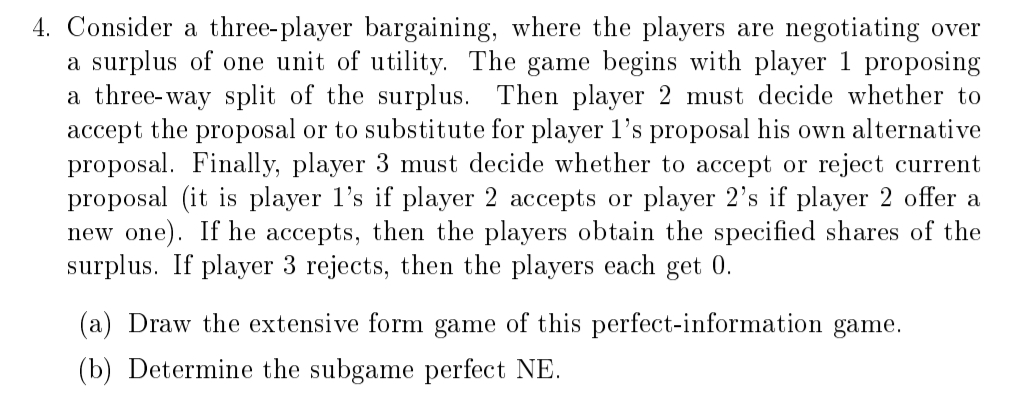

Transcribed Image Text:4. Consider a three-player bargaining, where the players are negotiating over
a surplus of one unit of utility. The game begins with player 1 proposing
a three-way split of the surplus. Then player 2 must decide whether to
accept the proposal or to substitute for player 1's proposal his own alternative
proposal. Finally, player 3 must decide whether to accept or reject current
proposal (it is player 1's if player 2 accepts or player 2's if player 2 offer a
new one). If he accepts, then the players obtain the specified shares of the
surplus. If player 3 rejects, then the players each get 0.
(a) Draw the extensive form game of this perfect-information game.
(b) Determine the subgame perfect NE.
Expert Solution

This question has been solved!
Explore an expertly crafted, step-by-step solution for a thorough understanding of key concepts.

This is a popular solution

Trending nowThis is a popular solution!

Step by stepSolved in 3 steps with 1 images

Knowledge Booster

Learn more about
Need a deep-dive on the concept behind this application? Look no further. Learn more about this topic, economics and related others by exploring similar questions and additional content below.Similar questions
- To Vote or Not to Vote Mr. and Mrs. Ward typically vote oppositely in elections and so their votes “cancel each other out.” They each gain two units of utility from a vote for their positions (and lose two units of utility from a vote against their positions). However, the bother of actually voting costs each one unit of utility. Diagram a game in which they choose whether to vote or not to vote. Mrs. Ward vote. don't vote Mr. Ward Vote. -1, -1. 1, -2 don't vote. -2, 1. 0,0?arrow_forward9. For the payoff matrix below, consider a sequential version of the game in which Player 2 moves first and then Player 1 moves second. Which of the following is not a correct statement? Player 1 Top Center Bottom Left 1,2 5,1 6,0 Player 2 Middle 7,1 11,2 -4,3 Right 10,4 1,0 8,5 The subgame perfect payoffs coincide with those of a Nash equilibrium b. Depending on Player 2's move, Player 1 will sometimes optimally choose Bottom c. Player 2 will choose Right in the subgame perfect equilibrium d. Player 2 would be willing to pay a positive $ amount to move first rather than second e. Player 1 would be willing to pay a larger $ amount than Player 2 to move firstarrow_forwardThank you for helping on this!arrow_forward
- Mr. and Mrs. Ward typically vote oppositely in elections and so their votes “cancel each other out.” They each gain two units of utility from a vote for their positions (and lose two units of utility from a vote against their positions). However, the bother of actually voting costs each one unit of utility. Diagram a game in which they choose whether to vote or not to vote.arrow_forward2arrow_forwardProve that in the variation on the centipede game given in figure 14.5(b) the unique sequential equilibrium described is, in fact, the unique Nash equilibrium. (Hint: Take some presumed Nash equilibrium and suppose information set 2n+ 1 [for player 2] is the first unreached information set. Derive an immediate contradiction. Then suppose that node (2n) t is the first unreached information set and derive a contradiction that is one degree removed from immediate.)arrow_forward
- 3. Consider a two-player, sequential-move game where each player can choose to play right or left. Player 1 moves first. Player 2 observes player 1's actual move and then decides to move right or left. If player 1 moves right, player 1 receives £20 and player 2 receives £45. If both move left, player 1 receives £15 and player 2 receives £30. If player 1 moves left and player 2 moves right, player 1 receives £40 and player 2 receives £40. a. Draw the above situation in the form of an extensive form game. b. Find the sub-game perfect Nash equilibrium of the extensive form game.arrow_forward2. Consider the following "centipede game." The game starts with player 1 choosing be- tween terminate (T) and continue (C). If player 1 chooses C, the game proceeds with player 2 choosing between terminate (t) and continue (c). The two players choose be- tween terminate and continue in turn if the other player chooses continue until the terminal nodes with (player l's payoff, player 2's payoff) are reached as shown below. TTTT Player 1 Player 2 Player 1 Player 2 (3, 3) t (1, 1) (0, 3) (2, 2) (1, 4) (a) List all possible strategies of each player. (b) Transform the game tree into a normal-form matrix representation. (c) Find all pure-strategy Nash equilibria. (d) Find the unique pure-strategy subgame-perfect equilibrium.arrow_forwardc) Consider the centipede game which illustrates the situation where it is mutually beneficial for all players to stay in a relationship while a player would like to exit the relationship if they know that the other player will exit in the next day. Note that the fourth day is the choice for Player 2 to move and choose either o or B. Use the logic of backwards induction to find the subgame perfect Nash equilibrium of the game in Figure 1. Figure 1: The Centipede Game (1 (64,16) (2,8) O (4,2) (16,4) (8,32)arrow_forward
- 3. Repeated Game Consider the game in which the stage game depicted below is infinitely repeated and in which both players discount future payoffs with discount factor 6 € [0, 1]. Player 1 E S Player 2 E 3,3 4, -1 S -1.4 1,1 (a) Suppose that both players play the tit-for-tat strategy. This strategy is characterized by exerting effort (playing E) in the first round. Then in future rounds, a player copies the action chosen by his opponent in the previous period (i.e if Player 2 shirks (plays S) in period 2, then Player 1 plays S in period 3). Then, for what values of d can tit-for-tat be supported on the equilibrium path of play? (b) Suppose that both players play the perfect tit-for-tat strategy. This strategy is characterized by exerting effort (playing E) in the first round. Then in future rounds, a player plays E unless the actions are disagreed in the previous period. Then, for what values of d can perfect tit-for-tat be supported on the equilibrium path of play?arrow_forward1. Consider a game of chicken: two players approach a narrow bridge with room only for one, and each chooses either to go through and hope the other guy backs off (call this action H, for "hawk"), or backs off to let the other go through (call this action D, for "dove"). If both players are normal, then each gets a payoff of -1 from a collision (i.e. if both choose H), 1 if they choose H against D, 0 if they choose D (regardless of what the other player chooses). Now perturb the game as follows: there is a chance p > 0 that P2 is a “violent type", who gets 1 from playing H regardless of Pl's action, and -1 from playing D, again regardless of P1's action. (a) Illustrate the game tree corresponding to the Harsanyi transformation of this game (i.e. the dynamic game of imperfect information in which nature moves first). (b) Illustrate the extended game (i.e. the normal form game corresponding to your game tree in part (a)). (c) Find all values of p for which there is a BNE in which P1…arrow_forward
arrow_back_ios
arrow_forward_ios
Recommended textbooks for you
 Principles of Economics (12th Edition)EconomicsISBN:9780134078779Author:Karl E. Case, Ray C. Fair, Sharon E. OsterPublisher:PEARSON
 Engineering Economy (17th Edition)EconomicsISBN:9780134870069Author:William G. Sullivan, Elin M. Wicks, C. Patrick KoellingPublisher:PEARSON
 Principles of Economics (MindTap Course List)EconomicsISBN:9781305585126Author:N. Gregory MankiwPublisher:Cengage Learning
 Managerial Economics: A Problem Solving ApproachEconomicsISBN:9781337106665Author:Luke M. Froeb, Brian T. McCann, Michael R. Ward, Mike ShorPublisher:Cengage Learning
 Managerial Economics & Business Strategy (Mcgraw-...EconomicsISBN:9781259290619Author:Michael Baye, Jeff PrincePublisher:McGraw-Hill Education
Principles of Economics (12th Edition)
Economics
ISBN:9780134078779
Author:Karl E. Case, Ray C. Fair, Sharon E. Oster
Publisher:PEARSON
Engineering Economy (17th Edition)
Economics
ISBN:9780134870069
Author:William G. Sullivan, Elin M. Wicks, C. Patrick Koelling
Publisher:PEARSON
Principles of Economics (MindTap Course List)
Economics
ISBN:9781305585126
Author:N. Gregory Mankiw
Publisher:Cengage Learning
Managerial Economics: A Problem Solving Approach
Economics
ISBN:9781337106665
Author:Luke M. Froeb, Brian T. McCann, Michael R. Ward, Mike Shor
Publisher:Cengage Learning
Managerial Economics & Business Strategy (Mcgraw-...
Economics
ISBN:9781259290619
Author:Michael Baye, Jeff Prince
Publisher:McGraw-Hill Education