

Advanced Engineering Mathematics
10th Edition
ISBN: 9780470458365
Author: Erwin Kreyszig
Publisher: Wiley, John & Sons, Incorporated
expand_more
expand_more
format_list_bulleted

Related questions
Question
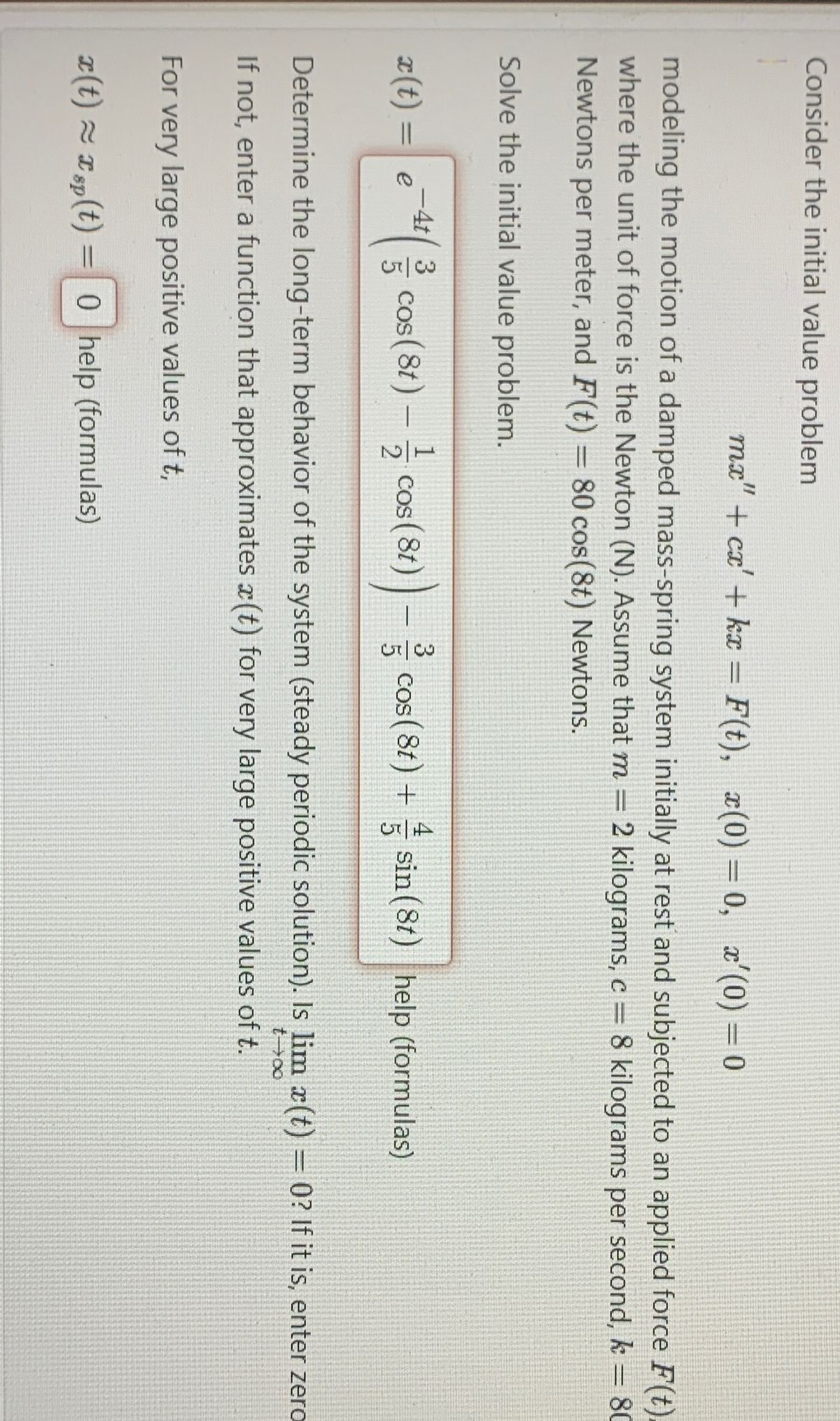

Transcribed Image Text:Consider the initial value problem
mx" + cx' + kx = F(t), x(0) = 0, x'(0) = 0
modeling the motion of a damped mass-spring system initially at rest and subjected to an applied force F(t),
where the unit of force is the Newton (N). Assume that m = 2 kilograms, c = 8 kilograms per second, k = 80
Newtons per meter, and F(t) = 80 cos(8t) Newtons.
Solve the initial value problem.
3
x(t) = e(cos(81) - ½ cos(81)) - cos(8) + sin(8) help (formulas)
Determine the long-term behavior of the system (steady periodic solution). Is lim x(t) = 0? If it is, enter zero
too
If not, enter a function that approximates x(t) for very large positive values of t.
For very large positive values of t,
x(t)=xsp(t) = 0 help (formulas)
Expert Solution

This question has been solved!
Explore an expertly crafted, step-by-step solution for a thorough understanding of key concepts.

Step by stepSolved in 5 steps

Knowledge Booster

Similar questions
- show all the steps and make sure answer is correctarrow_forward3. A projectile is fired with an initial velocity of 128 ft/s from a cannon at time t = 0 from a height of 32 ft above the ground and at an angle of 30° with the horizontal. (a) Determine: x '(0) and y'(0). (These values represent the horizontal and vertical components of the initial velocity vector.) (b) Use integration to determine the position equations: x(t) and y(t) for the projectile t seconds after being fired by assuming that the projectile is in freefall. Thus, x"(t)=0 ft/s² and y"(t)=-32 ft/s² for all t≥ 0. (Note: x"(t) and y"(t) are the horizontal & vertical components of the projectile's acceleration vector at time t.) (c) Determine the maximum height, H, of the projectile and its horizontal distance, D, from the launch site at the time that it achieves this height. (Hint: The maximal height is attained at the time, t*, at which y'(t*) = 0.) (d) Determine the range of the projectile, R. YA (0,32) - P. 32' 128 0=30° x'(0) y'(0) H R Pr=(x(t), y(t)) is the position of the…arrow_forward(1 point) Consider the initial value problem my" + cy' + ky = F(t), y(0) = 0, y'(0) = 0 modeling the motion of a spring-mass-dashpot system initially at rest and subjected to an applied force F(t), where the unit of force is the Newton (N). Assume that m = 2 kilograms, c = 8 kilograms per second, k = 80 Newtons per meter, and the applied force in Newtons is 30 if 0 ≤t≤/2, F(t) 0 ift > π/2. a. Solve the initial value problem, using that the displacement y(t) and velocity y' (t) remain continuous when the applied force is discontinuous. For 0 ≤ts/2, y(t) Fortπ/2, y(t) = 0 (-3/8)(e^(-21))cos(6t)-(1/8)(e^(-2t))sin(6t)+3/8 help (formulas) help (formulas) b. Determine the long-term behavior of the system. Is lim y(t) = 0? If it is, enter zero. If not, enter a function that approximates y(t) for very large positive values of t. t-∞ For very large positive values of t, y(t) ≈0 help (formulas)arrow_forward
- A spring mass system consists of a spring with spring constant k and an attached block of mass m is submerged in a liquid that produces a damping force Fr. m = 2 KG K = 36 N/m Fr 18 times the velocity of the center of mass of the block. = If the mass is initially released from rest 1m below the equilibrium position: Enter your answer in lower case, ex x"+ax'+bx=0 a. "The second degree equation that describe the motion of the center of mass of the attached block is b. The initial conditions are x(0)= c. The Arbitrary Constants that satisfy the IC's are C= the order does not matter" , x'(0)= C=arrow_forwardExplain and show all the steps. Please make sure the answer is correct. Thank you for your help!arrow_forward2) Assume that the motion of a mass-spring system with damping is governed by d+b+8y = 0, y(0) = 1, y'(0) = 0. Find the equation of motion for b = 3.arrow_forward
arrow_back_ios
arrow_forward_ios
Recommended textbooks for you
- Advanced Engineering MathematicsAdvanced MathISBN:9780470458365Author:Erwin KreyszigPublisher:Wiley, John & Sons, Incorporated
 Numerical Methods for EngineersAdvanced MathISBN:9780073397924Author:Steven C. Chapra Dr., Raymond P. CanalePublisher:McGraw-Hill Education
 Introductory Mathematics for Engineering Applicat...Advanced MathISBN:9781118141809Author:Nathan KlingbeilPublisher:WILEY
  Mathematics For Machine TechnologyAdvanced MathISBN:9781337798310Author:Peterson, John.Publisher:Cengage Learning,

Advanced Engineering Mathematics
Advanced Math
ISBN:9780470458365
Author:Erwin Kreyszig
Publisher:Wiley, John & Sons, Incorporated
Numerical Methods for Engineers
Advanced Math
ISBN:9780073397924
Author:Steven C. Chapra Dr., Raymond P. Canale
Publisher:McGraw-Hill Education
Introductory Mathematics for Engineering Applicat...
Advanced Math
ISBN:9781118141809
Author:Nathan Klingbeil
Publisher:WILEY
Mathematics For Machine Technology
Advanced Math
ISBN:9781337798310
Author:Peterson, John.
Publisher:Cengage Learning,