


Essentials Of Investments
11th Edition
ISBN: 9781260013924
Author: Bodie, Zvi, Kane, Alex, MARCUS, Alan J.
Publisher: Mcgraw-hill Education,
expand_more
expand_more
format_list_bulleted

Related questions

Concept explainers
Question
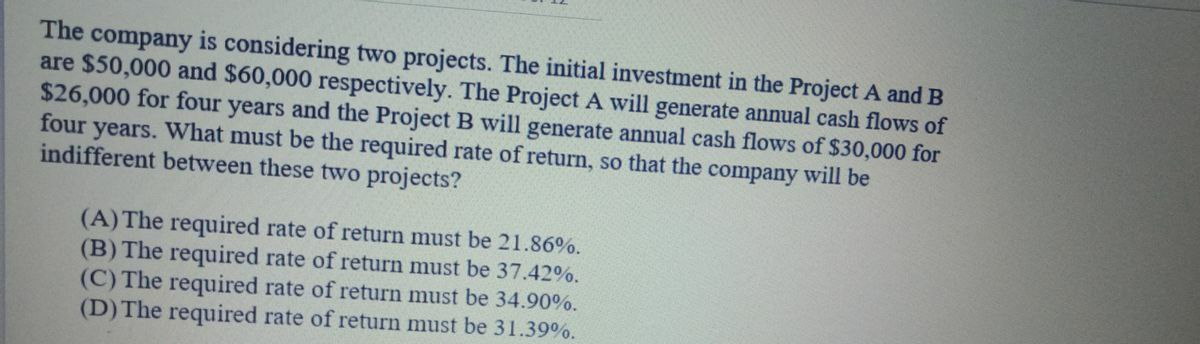

Transcribed Image Text:The company is considering two projects. The initial investment in the Project A and B
are $50,000 and $60,000 respectively. The Project A will generate annual cash flows of
$26,000 for four years and the Project B will generate annual cash flows of $30,000 for
four years. What must be the required rate of return, so that the company will be
indifferent between these two projects?
(A) The required rate of return must be 21.86%.
(B) The required rate of return must be 37.42%.
(C) The required rate of return must be 34.90%.
(D) The required rate of return must be 31.39%.
Expert Solution

This question has been solved!
Explore an expertly crafted, step-by-step solution for a thorough understanding of key concepts.

This is a popular solution

Trending nowThis is a popular solution!

Step by stepSolved in 2 steps with 1 images

Knowledge Booster


Learn more about
Need a deep-dive on the concept behind this application? Look no further. Learn more about this topic, finance and related others by exploring similar questions and additional content below.Similar questions
- A project that will provde annual cash flows of $3,000 for nine years costs $10,000 today. a. At a required return of 10 percent, what is the NPV of the project? Note: Do not round intermediate calculations and round your answer to 2 decimal places, e.g., 32.16. b. At a required return of 28 percent, what is the NPV of the project? Note: A negative answer should be indicated by a minus sign. Do not round intermediate calculations and round your answer to 2 decimal places, e.g., 32.16. c. At what discount rate would you be indifferent between accepting the project and rejecting it? Note: Do not round intermediate calculations and enter your answer as a percent rounded to 2 decimal places, e.g., 32.16. a. NPV b. NPV c. Discount rate %arrow_forwardAn investment has an installed cost of $537,800. The cash flows over the four-year life of the investment are projected to be $212,750, $229,350, $196,010, and $144,720, respectively. a. If the discount rate is zero, what is the NPV? (Do not round intermediate calculations.) b. If the discount rate is infinite, what is the NPV? (A negative answer should be indicated by a minus sign.) c. At what discount rate is the NPV just equal to zero? (Do not round intermediate calculations and enter your answer as a percent rounded to 2 decimal places, e.g., 32.16.) a. NPV b. NPV c. IRR %arrow_forwardConsider a project with free cash flow in one year of $139,138 or $187,005, with either outcome being equally likely. The initial investment required for the project is $110,000, and the project's cost of capital is 23%. The risk-free interest rate is 7%. (Assume no taxes or distress costs.) a. What is the NPV of this project? b. Suppose that to raise the funds for the initial investment, the project is sold to investors as an all-equity firm. The equity holders will receive the cash flows of the project in one year. How much money can be raised in this way that is, what is the initial market value of the unlevered equity? c. Suppose the initial $110,000 is instead raised by borrowing at the risk-free interest rate. What are the cash flows of the levered equity, and what is its initial value according to M&M? a. What is the NPV of this project? The NPV is $ 22578. (Round to the nearest dollar.) b. Suppose that to raise the funds for the initial investment, the project is sold to…arrow_forward
- The James Company is considering an investment with a cost today of $1,500,000 and which will produce the following net inflows: Year 1 600,000 Year 2 300,000 Year 3 200,000 Year 4 400,000 Year 5 500,000 What is the Payback Period for the investment?arrow_forwardYou are evaluating a project that will cost $502,000, but is expected to produce cash flows of $127,000 per year for 10 years, with the first cash flow in one year. Your cost of capital is 10.7% and your company's preferred payback period is three years or less. a. What is the payback period of this project? b. Should you take the project if you want to increase the value of the company? a. What is the payback period of this project? The payback period is years. (Round to two decimal places.) b. Should you take the project if you want to increase the value of the company? (Select from the drop-down menus.) If you want to increase the value of the company you take the project since the NPV is will not willarrow_forwardA project that will provde annual cash flows of $3,050 for nine years costs $10,200 today. a. At a required return of 11 percent, what is the NPV of the project? Note: Do not round intermediate calculations and round your answer to 2 decimal places, e.g., 32.16. b. At a required return of 27 percent, what is the NPV of the project? Note: A negative answer should be indicated by a minus sign. Do not round intermediate calculations and round your answer to 2 decimal places, e.g., 32.16. c. At what discount rate would you be indifferent between accepting the project and rejecting it? Note: Do not round intermediate calculations and enter your answer as a percent rounded to 2 decimal places, e.g., 32.16. a. NPV b. NPV c. Discount rate %arrow_forward
- You are evaluating an investment project costing $42,000 initially. The project will provide $3,000 in after - tax cash flows in the first year, and $7,000 each year thereafter for 10 years. The maximum payback period for your company is 6 years. What is the payback period for this project?arrow_forwardA project that will provde annual cash flows of $2,550 for nine years costs $10,500 today. a. At a required return of 11 percent, what is the NPV of the project? (Do not round intermediate calculations and round your answer to 2 decimal places, e.g., 32.16.) b. At a required return of 27 percent, what is the NPV of the project? (A negative answer should be indicated by a minus sign. Do not round intermediate calculations and round your answer to 2 decimal places, e.g., 32.16.) c. At what discount rate would you be indifferent between accepting the project and rejecting it? (Do not round intermediate calculations and enter your answer as a percent rounded to 2 decimal places, e.g., 32.16.) a. NPV b. NPV c. Discount ratearrow_forwardConnor Corporation is considering two projects (see below). For your analysis, assume these projects are mutually exclusive with a required rate of return of 12%. project 1 project 2 initial investment $(510,000) $(685,000) cash flow year 1 485,000 610,000 Compute the following for each project: NPV (net present value) PI (profitability index) IRR (internal rate of return) Based on your analysis, answer the following questions : Which is the best choice? Why? Which project should be selected and why? If the projects had the same IRR amounts but different NPV totals, then how would you know which project to select? Explain.arrow_forward
- You are responsible to manage an IS project with a 4-year horizon. The annal cost of the project is estimated at $40,000 per year, and a one-time costs of $120,000. The annual monetary benefit of the project is estimated at $96,000 per year with a discount rate of 6 percent. a. Calculate the overall return on investment (ROI) of the project. b. Perform a break-even analysis (BEA). At what year does break-even occur?arrow_forwardNPV and IRR Benson Designs has prepared the following estimates for a long-term project it is considering. The initial investment is $41,150, and the project is expected to yield after-tax cash inflows of $9,000 per year for 7 years. The firm has a cost of capital of 8%. a. Determine the net present value (NPV) for the project. b. Determine the internal rate of return (IRR) for the project. c. Would you recommend that the firm accept or reject the project? a. The NPV of the project is $. (Round to the nearest cent.) Text dia Librai I Calculat Resource Enter vour answer in the answer box and then click Check Answer. Check Answer ic Study es Clear parts remaining nunication Tools > O Type here to search insert ( to |立arrow_forwardYou are considering opening a new plant. The plant will cost $104.8 million upfront and will take one year to build. After that, it is expected to produce profits of $28.2 million at the end of every year of production. The cash flows are expected to last forever. Calculate the NPV of this investment opportunity if your cost of capital is 7.8%. Should you make the investment? Calculate the IRR. Does the IRR rule agree with the NPV rule?arrow_forward
arrow_back_ios
SEE MORE QUESTIONS
arrow_forward_ios
Recommended textbooks for you
- Essentials Of InvestmentsFinanceISBN:9781260013924Author:Bodie, Zvi, Kane, Alex, MARCUS, Alan J.Publisher:Mcgraw-hill Education,
 Foundations Of FinanceFinanceISBN:9780134897264Author:KEOWN, Arthur J., Martin, John D., PETTY, J. WilliamPublisher:Pearson,
 Fundamentals of Financial Management (MindTap Cou...FinanceISBN:9781337395250Author:Eugene F. Brigham, Joel F. HoustonPublisher:Cengage Learning
 Corporate Finance (The Mcgraw-hill/Irwin Series i...FinanceISBN:9780077861759Author:Stephen A. Ross Franco Modigliani Professor of Financial Economics Professor, Randolph W Westerfield Robert R. Dockson Deans Chair in Bus. Admin., Jeffrey Jaffe, Bradford D Jordan ProfessorPublisher:McGraw-Hill Education
Essentials Of Investments
Finance
ISBN:9781260013924
Author:Bodie, Zvi, Kane, Alex, MARCUS, Alan J.
Publisher:Mcgraw-hill Education,
Foundations Of Finance
Finance
ISBN:9780134897264
Author:KEOWN, Arthur J., Martin, John D., PETTY, J. William
Publisher:Pearson,
Fundamentals of Financial Management (MindTap Cou...
Finance
ISBN:9781337395250
Author:Eugene F. Brigham, Joel F. Houston
Publisher:Cengage Learning
Corporate Finance (The Mcgraw-hill/Irwin Series i...
Finance
ISBN:9780077861759
Author:Stephen A. Ross Franco Modigliani Professor of Financial Economics Professor, Randolph W Westerfield Robert R. Dockson Deans Chair in Bus. Admin., Jeffrey Jaffe, Bradford D Jordan Professor
Publisher:McGraw-Hill Education