

Chemistry
10th Edition
ISBN: 9781305957404
Author: Steven S. Zumdahl, Susan A. Zumdahl, Donald J. DeCoste
Publisher: Cengage Learning
expand_more
expand_more
format_list_bulleted

Related questions
Question
thumb_up100%
At elevated temperatures, NaHCO3 is converted quantitatively to Na2CO3:
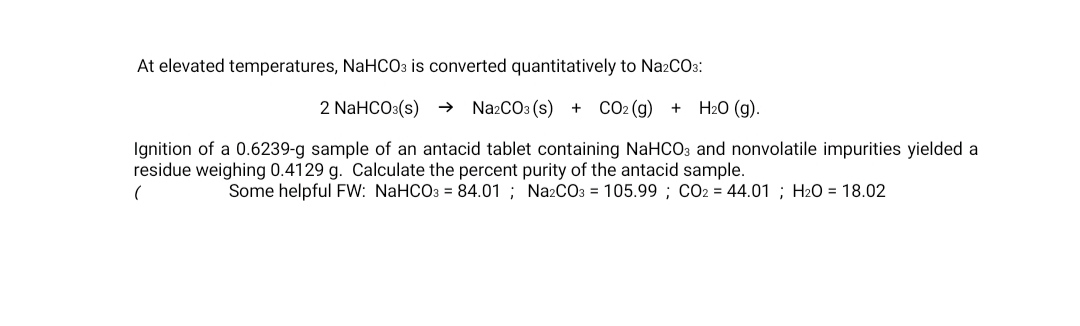

Transcribed Image Text:At elevated temperatures, NaHCO3 is converted quantitatively to Na2CO3:
2 NaHCO3(s)
→ NazCO3 (s) + CO2 (g) + H20 (g).
Ignition of a 0.6239-g sample of an antacid tablet containing NaHCO3 and nonvolatile impurities yielded a
residue weighing 0.4129 g. Calculate the percent purity of the antacid sample.
Some helpful FW: NaHCO3 = 84.01 ; Na2CO3 = 105.99 ; CO2 = 44.01 ; Hz0 = 18.02
Expert Solution

This question has been solved!
Explore an expertly crafted, step-by-step solution for a thorough understanding of key concepts.

This is a popular solution

Trending nowThis is a popular solution!

Step by stepSolved in 5 steps with 4 images

Knowledge Booster


Learn more about
Need a deep-dive on the concept behind this application? Look no further. Learn more about this topic, chemistry and related others by exploring similar questions and additional content below.Similar questions
- QUESTION 30 Which statement best explains the toxicity of trivalent lanthanide cations to plant life O The lanthanide ion replaces calcium in the oxygen evolving centre and the resulting hydroxide intermediate is not sufficiently nucleophilic to attack the transient manganyl(v) species in the S4 state O The lanthanide ion replaces calcium in the oxygen evolving centre and the resulting aqua intermediate is not sufficiently acidic to generate a hydroxide intermediate O The lanthanide coordinates to pheophytin disrupting the electron transport chain O The lanthanide ion replaces magnesium in the P680 causing a shift in its redox potential O The lanthanide cation precipitates chloride from the active site of the oxygen evolving centrearrow_forwardFe3+(aq) + SCN–(aq) ⇆ FeSCN2+(aq) Suppose that the solution of NaSCN was accidentally prepared using too much solid NaSCN, so that that solution had a higher [SCN-] value than expected. How would the resulting measured Keq value differ from the true Keq value: too large, too small, or unaffected? Explainarrow_forwardIf the concentration of an acid in solution is 2.2 times larger than the concentration of its conjugate base, and the pH of the solution is 3.5, what is the pKa of the acid? Include the answer to 3 significant figuresarrow_forward
- Consider the following data: HX ↔ X− + H+HX ↔ X- + H+ Ka = 6.83⋅10−66.83⋅10-6 H2A ↔ HA− + H+H2A ↔ HA- + H+ Ka = 6.85⋅10−86.85⋅10-8 Calculate the Keq for the following reaction: HA−HA- + HXHX ↔↔ H2AH2A + X−X- Record your answer in scientific notation to 3 sig figs.arrow_forwardDraw the amino acid Asparagine with the biologically-preferred stereochemistry and ionization expected at pH 7.4.arrow_forwardHow does NaC2H3O2 act as a buffer?arrow_forward
- Consider the following five weak acids: Succinic acid: pKa = 4.16HOBr: Ka = 2.06 x 10⁻⁹Dinicotinic: pKa = 2.08Nitrobenzoic: Ka = 6.95 x 10⁻³Saccharin: pKa = 11.68 Order these acids from the strongest (1) to the weakest (5)arrow_forwardFor an acid HA with a pKa of 5.2, what is the ratio of the concentration of the conjugate base to that of the acid at pH 7.2.arrow_forwardExplain why a pKa is not found for the strong acid, but one will be found for the weak acid.arrow_forward
- For each of the following pairs of substances, predict which member of the pair will have the higher IMF, and indicate why. NaF and MgO Na2O and SiC HCl and HF Ar and NOarrow_forward5). Which of the following compound has lowest pKa? H3C (A) COOH F (B) COOH 6). What is the product nhtained from the full COOH (C) COOH (D) COOH (E)arrow_forwardIf an acid has a Ka of 2.12 x 10⁻³, what is its pKa?arrow_forward
arrow_back_ios
SEE MORE QUESTIONS
arrow_forward_ios
Recommended textbooks for you
- ChemistryChemistryISBN:9781305957404Author:Steven S. Zumdahl, Susan A. Zumdahl, Donald J. DeCostePublisher:Cengage Learning
 ChemistryChemistryISBN:9781259911156Author:Raymond Chang Dr., Jason Overby ProfessorPublisher:McGraw-Hill Education
 Principles of Instrumental AnalysisChemistryISBN:9781305577213Author:Douglas A. Skoog, F. James Holler, Stanley R. CrouchPublisher:Cengage Learning
  Organic ChemistryChemistryISBN:9780078021558Author:Janice Gorzynski Smith Dr.Publisher:McGraw-Hill Education
 Chemistry: Principles and ReactionsChemistryISBN:9781305079373Author:William L. Masterton, Cecile N. HurleyPublisher:Cengage Learning
 Elementary Principles of Chemical Processes, Bind...ChemistryISBN:9781118431221Author:Richard M. Felder, Ronald W. Rousseau, Lisa G. BullardPublisher:WILEY
Chemistry
Chemistry
ISBN:9781305957404
Author:Steven S. Zumdahl, Susan A. Zumdahl, Donald J. DeCoste
Publisher:Cengage Learning
Chemistry
Chemistry
ISBN:9781259911156
Author:Raymond Chang Dr., Jason Overby Professor
Publisher:McGraw-Hill Education
Principles of Instrumental Analysis
Chemistry
ISBN:9781305577213
Author:Douglas A. Skoog, F. James Holler, Stanley R. Crouch
Publisher:Cengage Learning
Organic Chemistry
Chemistry
ISBN:9780078021558
Author:Janice Gorzynski Smith Dr.
Publisher:McGraw-Hill Education
Chemistry: Principles and Reactions
Chemistry
ISBN:9781305079373
Author:William L. Masterton, Cecile N. Hurley
Publisher:Cengage Learning
Elementary Principles of Chemical Processes, Bind...
Chemistry
ISBN:9781118431221
Author:Richard M. Felder, Ronald W. Rousseau, Lisa G. Bullard
Publisher:WILEY