

Introductory Circuit Analysis (13th Edition)
13th Edition
ISBN: 9780133923605
Author: Robert L. Boylestad
Publisher: PEARSON
expand_more
expand_more
format_list_bulleted

Related questions

Concept explainers
Question
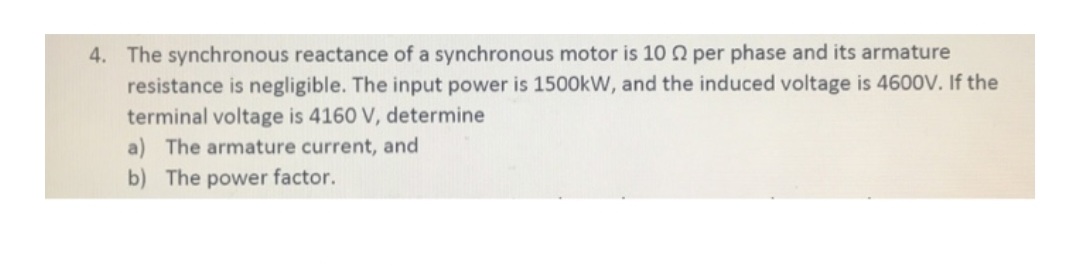

Transcribed Image Text:4. The synchronous reactance of a synchronous motor is 102 per phase and its armature
resistance is negligible. The input power is 1500kW, and the induced voltage is 4600V. If the
terminal voltage is 4160 V, determine
a) The armature current, and
b) The power factor.
Expert Solution

This question has been solved!
Explore an expertly crafted, step-by-step solution for a thorough understanding of key concepts.

Step by stepSolved in 5 steps with 10 images

Knowledge Booster


Learn more about
Need a deep-dive on the concept behind this application? Look no further. Learn more about this topic, electrical-engineering and related others by exploring similar questions and additional content below.Similar questions
- Discuss the behaviour of an induction motor when it is rotating at synchronous speed.arrow_forwardA 3-phase, 60 Hz induction motor has two poles. If the slip is 2% at a certain load, determine the synchronous speed, the speed of the rotor and the frequency of the induced e.m.f.'s in the rotor.arrow_forward2. A) Which of the following 3-phase motors has a wire wound rotor? a) polyphase induction motor b) polyphase wound rotor motor c) both "a" and "b" d) neither "a" nor "b" B) Which of the following 3-phase motors has a more maintenance free design. a) 3-phase wire wound rotor b) 3-phase squirrel-cage rotorarrow_forward
- A 440 V three phase, delta connected synchronous motor has load of 9 kW and synchronous reactance of 36 2 per phase with negligible armature resistance. If the excitation voltage is 560 V, then the power factor of motor is 0.5 0.85 O 0.97 O 0.44arrow_forwardA 3 phase, 1500 rpm, 2200 V, star connected synchronous motor has an impedance of 0.4+j90 per phase. At some excitation 2900 V is induced in the armature. Find the maximum torque developed by motor before the motor breaks out of synchronism. Also find the load angle this time.arrow_forward
arrow_back_ios
arrow_forward_ios
Recommended textbooks for you
- Introductory Circuit Analysis (13th Edition)Electrical EngineeringISBN:9780133923605Author:Robert L. BoylestadPublisher:PEARSON
 Delmar's Standard Textbook Of ElectricityElectrical EngineeringISBN:9781337900348Author:Stephen L. HermanPublisher:Cengage Learning
 Programmable Logic ControllersElectrical EngineeringISBN:9780073373843Author:Frank D. PetruzellaPublisher:McGraw-Hill Education
  Fundamentals of Electric CircuitsElectrical EngineeringISBN:9780078028229Author:Charles K Alexander, Matthew SadikuPublisher:McGraw-Hill Education
 Electric Circuits. (11th Edition)Electrical EngineeringISBN:9780134746968Author:James W. Nilsson, Susan RiedelPublisher:PEARSON
 Engineering ElectromagneticsElectrical EngineeringISBN:9780078028151Author:Hayt, William H. (william Hart), Jr, BUCK, John A.Publisher:Mcgraw-hill Education,
Introductory Circuit Analysis (13th Edition)
Electrical Engineering
ISBN:9780133923605
Author:Robert L. Boylestad
Publisher:PEARSON
Delmar's Standard Textbook Of Electricity
Electrical Engineering
ISBN:9781337900348
Author:Stephen L. Herman
Publisher:Cengage Learning
Programmable Logic Controllers
Electrical Engineering
ISBN:9780073373843
Author:Frank D. Petruzella
Publisher:McGraw-Hill Education
Fundamentals of Electric Circuits
Electrical Engineering
ISBN:9780078028229
Author:Charles K Alexander, Matthew Sadiku
Publisher:McGraw-Hill Education
Electric Circuits. (11th Edition)
Electrical Engineering
ISBN:9780134746968
Author:James W. Nilsson, Susan Riedel
Publisher:PEARSON
Engineering Electromagnetics
Electrical Engineering
ISBN:9780078028151
Author:Hayt, William H. (william Hart), Jr, BUCK, John A.
Publisher:Mcgraw-hill Education,