


College Physics
11th Edition
ISBN: 9781305952300
Author: Raymond A. Serway, Chris Vuille
Publisher: Cengage Learning
expand_more
expand_more
format_list_bulleted

Related questions
Question
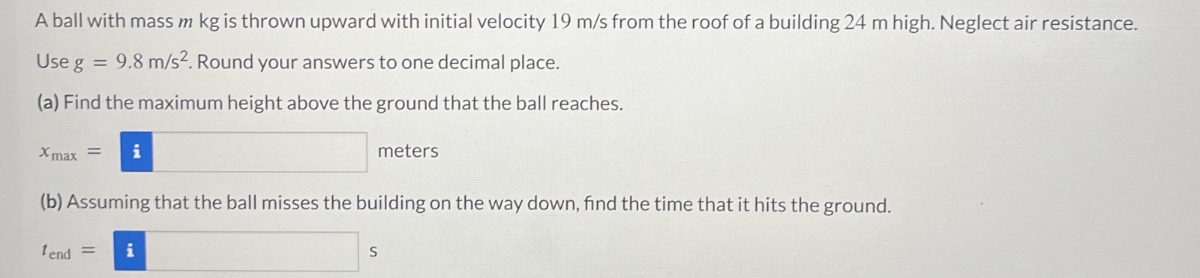

Transcribed Image Text:A ball with mass m kg is thrown upward with initial velocity 19 m/s from the roof of a building 24 m high. Neglect air resistance.
Use g = 9.8 m/s². Round your answers to one decimal place.
(a) Find the maximum height above the ground that the ball reaches.
Xmax=
meters
(b) Assuming that the ball misses the building on the way down, find the time that it hits the ground.
1 end = i
S
Expert Solution

This question has been solved!
Explore an expertly crafted, step-by-step solution for a thorough understanding of key concepts.

Step by stepSolved in 2 steps with 4 images

Knowledge Booster

Similar questions
- + V = 0 m/s y A coin was tossed vertically straight upward with initial velocity 44 m/s. Find the maximum height that coin reached. Select one: O a. 98.6748 m O b. 2.2426 m O c. 78.9399 m O d. 197.3496 marrow_forwardDuring 9.67 s, a motorcyclist changes his velocity from v1,x = -39.1 m/s and v1,y = 13.7 m/s to v2,x = -23.7 m/s and v2.y = 29.9 m/s. Find the components of the motorcycle's average acceleration during this process, a,v,x and av.y. Aav,x m/s? dav,y m/s? IIarrow_forwardA student drove to the university from her home and noted that the odometer reading of her car increased by 12.0 km. The trip took 17.9 min. a.If the straight-line distance from her home to the university is 10.310.3 km in a direction 28.028.0º south of east, what was her average velocity? (magnitude and direction south of east) b.If she returned home by the same path 6.50h after she left, what was her average speed for the entire trip?arrow_forward
- QUESTION 2 A ball is thrown straight up in the air. When it reaches a height that is n times smaller than the maximum height it can reach, its speed is v. Calculate the maximum height, in meters. n = 3.9 v = 16.8 m/s to saue all answers.arrow_forward3. An object is dropped from a height h above the surface of the Earth such that it experiences an initial acceleration of 0.76g. Find the height h above the surface of the Earth. ME a = G (R, +h)arrow_forwardI need part d and earrow_forward
- What is her velocity at 15 s?arrow_forwardA bb is shot downward from the top of a building leaving the barrel with an initial speed of 90.3 m/s downward. The top of the building is 60.1 m above the ground. How much time elapses between the instant it leaves the barrel and the instant of impact with the ground? Round your answer to 3 decimal places.arrow_forward3. Bob (52.0kg) was curious about the amount of air resistance (friction) that would act on him as he fell through the air, so he conducted an experiment. He stepped out of a third story window, 15.0m above the ground, and measured that it took 1.94s to hit the ground (don't worry, there was a soft mat to cushion the impact). Assuming his initial velocity was zero as he stepped out of the window, determine the force of air friction that acted on Bob as he fell.arrow_forward
- Helparrow_forwardFinding x(t) and v(t) by Integration 5. The acceleration of a jeepney is given by a, (t) = at – ßt? т where a = 1.50 m/.3 and ß = 0.120 m /s4 The motorcycle is at rest at the origin when time t = 0. a. Find its position and velocity as functions of time. b. Calculate the maximum velocity it attains.arrow_forwardolem 1. A stone is dropped from the top of a building and falls freely from rest. What is its position (height) and its velocity after 1.0s, 2.0s, and 3.0s? To find for the position (height), we will use: Know that initial velocity (vi) = 0 a. Find h after 1.0s h=0(1.0s)-(9.8 m/s)(1.0s)2 2 |h=v₁t - 9² 2 h=0-9.8m 2 h=-4.9 m (negative sign denotes downward direction) b. Find h after 2.0s h=0(2.0s) - (9.8 m/s²)(2.0s)² 2 h=0-39.2 m 2 h = -19.6 m or 19.6 m downward Given: v₁ = 20 m/s Find: a. v after 1s b. v after 5s c. d after 1s d. t from origin to maximum height d from origin to maximum height e. Solutions: a. y after is use: V₁ = v₁ - gt vy=20 m/s-(9.8 m/s²)(1.0s) vy= 20 m/s -9.8 m/s vy=10.2 m/s b. v after 2s use: Sample Problem 2. A boy threw a ball upward with an initial velocity of 20 m/s and was able to catch it before it reached the ground on its return. a. What was the ball's velocity after 1s? b. What was the ball's velocity after 2s? c. What was its displacement after 1s? d. How…arrow_forward
arrow_back_ios
arrow_forward_ios
Recommended textbooks for you
- College PhysicsPhysicsISBN:9781305952300Author:Raymond A. Serway, Chris VuillePublisher:Cengage Learning
 University Physics (14th Edition)PhysicsISBN:9780133969290Author:Hugh D. Young, Roger A. FreedmanPublisher:PEARSON
 Introduction To Quantum MechanicsPhysicsISBN:9781107189638Author:Griffiths, David J., Schroeter, Darrell F.Publisher:Cambridge University Press
  Physics for Scientists and EngineersPhysicsISBN:9781337553278Author:Raymond A. Serway, John W. JewettPublisher:Cengage Learning
 Lecture- Tutorials for Introductory AstronomyPhysicsISBN:9780321820464Author:Edward E. Prather, Tim P. Slater, Jeff P. Adams, Gina BrissendenPublisher:Addison-Wesley
 College Physics: A Strategic Approach (4th Editio...PhysicsISBN:9780134609034Author:Randall D. Knight (Professor Emeritus), Brian Jones, Stuart FieldPublisher:PEARSON
College Physics
Physics
ISBN:9781305952300
Author:Raymond A. Serway, Chris Vuille
Publisher:Cengage Learning
University Physics (14th Edition)
Physics
ISBN:9780133969290
Author:Hugh D. Young, Roger A. Freedman
Publisher:PEARSON
Introduction To Quantum Mechanics
Physics
ISBN:9781107189638
Author:Griffiths, David J., Schroeter, Darrell F.
Publisher:Cambridge University Press
Physics for Scientists and Engineers
Physics
ISBN:9781337553278
Author:Raymond A. Serway, John W. Jewett
Publisher:Cengage Learning
Lecture- Tutorials for Introductory Astronomy
Physics
ISBN:9780321820464
Author:Edward E. Prather, Tim P. Slater, Jeff P. Adams, Gina Brissenden
Publisher:Addison-Wesley
College Physics: A Strategic Approach (4th Editio...
Physics
ISBN:9780134609034
Author:Randall D. Knight (Professor Emeritus), Brian Jones, Stuart Field
Publisher:PEARSON