

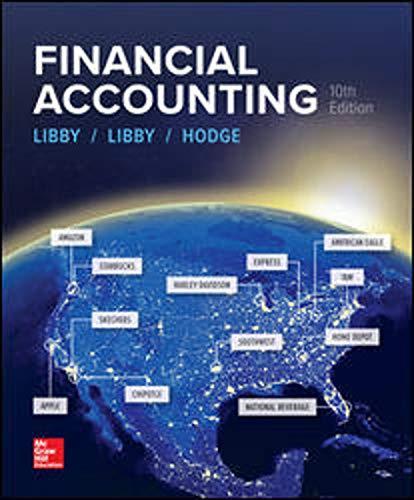
FINANCIAL ACCOUNTING
10th Edition
ISBN: 9781259964947
Author: Libby
Publisher: MCG
expand_more
expand_more
format_list_bulleted

Related questions

Concept explainers
Question
(a) If
would
(i) Improve (ii) Reduce or (iii) Not change Current Ratio
(1) Bills Receivable drawn
(2) Bills Receivable Dishonoured
(3) Bills Receivable endorsed to Creditors
(4) Sales of Goods for cash at par
(5) Sales of Goods for cash at Profit
(6) Sales of Assets for Cash
(7) Bills Payable given to creditors
(b) If the
would
(ii) Improve (ii) Reduce or (iii) Not change Liquid Ratio
1) Purchase of goods for cash
2) Purchase of goods on credit
3) Payment of Tax Provision
4) Sales of short term investment at par
5) Sales of Investment at profit.
Expert Solution

This question has been solved!
Explore an expertly crafted, step-by-step solution for a thorough understanding of key concepts.

Step by stepSolved in 2 steps with 1 images

Knowledge Booster


Learn more about
Need a deep-dive on the concept behind this application? Look no further. Learn more about this topic, accounting and related others by exploring similar questions and additional content below.Similar questions
- When current E&P has a deficit and accumulated E&P is positive, the two accounts are netted at the date of the distribution. If a positive balance results, the distribution is a dividend to the extent of the balance. This statement is False. Am I correct? If not, please explain. Thank you in advance!arrow_forward8. The timing of income from services can often be controlled through the use of: a.U.S. GAAP accounting. b.The cash method of accounting. c.Service accounting. d.The accrual method of accounting. e.IFRS accounting. 9. The primary purpose of the imputed interest rules is to prevent income shifting via interest-free loans. True Falsearrow_forwardWhich of the following normally has a net credit balance? A. Asset accounts such as cash, accounts receivable, inventory, and equipment B. Expenses that decrease retained earnings C. Dividends that decrease retained earnings D. Revenues that increase retained earningsarrow_forward
- Which one of the following accounts is unlikely to ever be seperately disclosed in the income statement? O A. Cost of sales O B. Bad debts O C. Interest on current bank account O D. Depreciationarrow_forwardwhich is an example of prepaid expense? A. unearned fees B. supplies C. unearned subscriptions D. accounts receivablearrow_forwardWhich of the following states that a transaction is not recorded in the books of accounts unless it is measurable in terms of money? a. Matching principle. b. Revenue recognition principle. c. Time period assumption. d. Monetary unit assumption.arrow_forward
- Which of the following is not disclosed in the financial statements? A. Trade discount received B. Cash discount received C. Cash discount allowed D. Sales returnarrow_forward41. Realization of revenue occurs when a. the item is formally recorded and reported in the financial statements b. noncash resources are converted into cash or rights to cash c. the actual exchange of noncash resources into cash С. d. when a transaction is both realized and realizable 42.A revenue recognition method that recognizes revenue before the time of sale is a. percentage-of-completion b. installment c. cost recovery d. point of sale С.arrow_forwardWhich of the following entries is not one a firm would normally make? A)Debit cash, credit accounts receivable B)Debit cash, credit revenue C)Debit cash, credit salaries payable D)Debit cash, credit loans payablearrow_forward
- Which of the following transactions affects both the income statement and the balance sheet? O Collection of accounts receivable O Loan from bank O Depreciation on equipment O Declaration of cash dividend O Purchase of inventory on accountarrow_forwardQuestion 3arrow_forwardtopic: double-entry accounting indicate how to increase each of the accounts below (credit or debit) cash- accounts payable- supplies- accounts receivable-arrow_forward
arrow_back_ios
SEE MORE QUESTIONS
arrow_forward_ios
Recommended textbooks for you
 AccountingAccountingISBN:9781337272094Author:WARREN, Carl S., Reeve, James M., Duchac, Jonathan E.Publisher:Cengage Learning,
 Accounting Information SystemsAccountingISBN:9781337619202Author:Hall, James A.Publisher:Cengage Learning,
 Horngren's Cost Accounting: A Managerial Emphasis...AccountingISBN:9780134475585Author:Srikant M. Datar, Madhav V. RajanPublisher:PEARSON
 Intermediate AccountingAccountingISBN:9781259722660Author:J. David Spiceland, Mark W. Nelson, Wayne M ThomasPublisher:McGraw-Hill Education
 Financial and Managerial AccountingAccountingISBN:9781259726705Author:John J Wild, Ken W. Shaw, Barbara Chiappetta Fundamental Accounting PrinciplesPublisher:McGraw-Hill Education
Accounting
Accounting
ISBN:9781337272094
Author:WARREN, Carl S., Reeve, James M., Duchac, Jonathan E.
Publisher:Cengage Learning,
Accounting Information Systems
Accounting
ISBN:9781337619202
Author:Hall, James A.
Publisher:Cengage Learning,
Horngren's Cost Accounting: A Managerial Emphasis...
Accounting
ISBN:9780134475585
Author:Srikant M. Datar, Madhav V. Rajan
Publisher:PEARSON
Intermediate Accounting
Accounting
ISBN:9781259722660
Author:J. David Spiceland, Mark W. Nelson, Wayne M Thomas
Publisher:McGraw-Hill Education
Financial and Managerial Accounting
Accounting
ISBN:9781259726705
Author:John J Wild, Ken W. Shaw, Barbara Chiappetta Fundamental Accounting Principles
Publisher:McGraw-Hill Education