


Related questions
Question
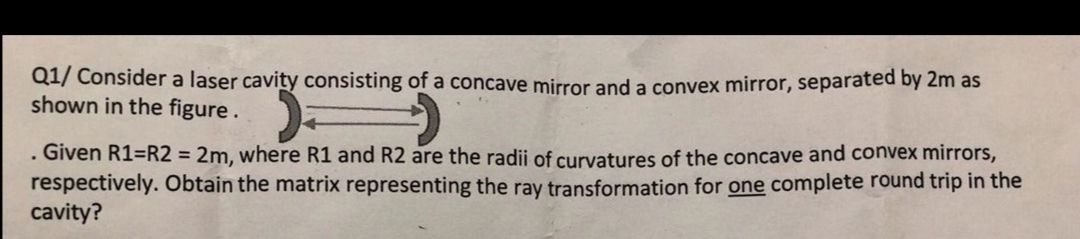

Transcribed Image Text:Q1/ Consider a laser cavity consisting of a concave mirror and a convex mirror, separated by 2m as
shown in the figure.
. Given R1=R2 = 2m, where R1 and R2 are the radii of curvatures of the concave and convex mirrors,
respectively. Obtain the matrix representing the ray transformation for one complete round trip in the
cavity?
Expert Solution

This question has been solved!
Explore an expertly crafted, step-by-step solution for a thorough understanding of key concepts.

Step by stepSolved in 2 steps

Knowledge Booster

Similar questions
- Homework 11, Problem 3arrow_forwardIn order to identify an unknown material you are asked to solve for the critical angle of the material. In order to test this you set up a beam of light that strikes the unknown substance from air (n = 1.0) at an angle of 30° with respect to the normal. It continues on in the substance at an angle of 23° with respect to the normal. What is the critical angle for the unknown substance? 51° 55° 60° 63°arrow_forwardThe drawing shows a rectangular block of glass (n = 1.52) surrounded by a liquid with n = 1.75. A ray of light is incident on the glass at point A with a 30.0° angle of incidence. At what angle does the ray leave the glass at point B? Number i Units 4arrow_forward
- Let IB and OB be distances from the plane mirror to the image and object, respectively. Show that IB = OB. Prove that image and object have the same size.arrow_forwardThe drawing shows a ray of light traveling from point A to point B, a distance of 7.80 m in a material than has an index of refraction n1. At point B, the light encounters a different substance whose index of refraction is n2 = 1.63. The light strikes the interface at the critical angle of Thetac = 49.2°. How much time does it take for the light to travel from A to B?arrow_forwardcem 1 1 of 1 Use this information for parts G, H and I. The sideview mirror on your car is convex. When looking in this mirror, you see a car that has an actual distance of 100 m behind you (the distance from the car to the mirror) and the image appears to be only -1.961 m from the mirror. Part G What is the focal length of this mirror? Answer in units of m to four significant figures. Do not Include the units symbol. Submit Request Answer Part H If the image of the car appears to be 2.941×10¬2 m tall, what is the height of the actual car? Answer in units of m to four significant figures. Do not include the units symbol. ? Submit Request Answer Part Iarrow_forward
- Consider a mirror lying along the x-axis in R2. A laser starts at the point (−2, 6) and is fired in the direction of ⟨4, −3⟩. The beam travels until it hits the mirror, where it reflects off the mirror and then travels until it hits a wall on the line x = 20. (a) Give a parametrization for the initial path of the laser. (b) At what point does this beam hit the mirror? (c) Give a parametrization for the path of the reflected beam. (d) At what point does this beam hit the wall?arrow_forwardA mirror is rotating, reflecting the incident rays. The angular speed of the reflected ray is wB. VWhat is the angular speed of the rotating mirror, WM? 2WB WB 0.5wBarrow_forwardTwo plane mirrors make the angle a = 58.0° between them. A ray of light incident on one of the mirrors is reflected and it hits the second mirror, as shown in the figure. Determine the angle ẞ between the ray incident on the first mirror and the ray reflected off of the second mirror. B = Barrow_forward
arrow_back_ios
arrow_forward_ios