


College Physics
11th Edition
ISBN: 9781305952300
Author: Raymond A. Serway, Chris Vuille
Publisher: Cengage Learning
expand_more
expand_more
format_list_bulleted

Related questions

Concept explainers
Question
The figure below shows a plastic rod of length L with a total charge Q evenly distributed over the rod. The rod is bent into an arc with a radius R and an angle of θ = 45°. What is the electric field (magnitude and direction) at the location indicated by the black dot?
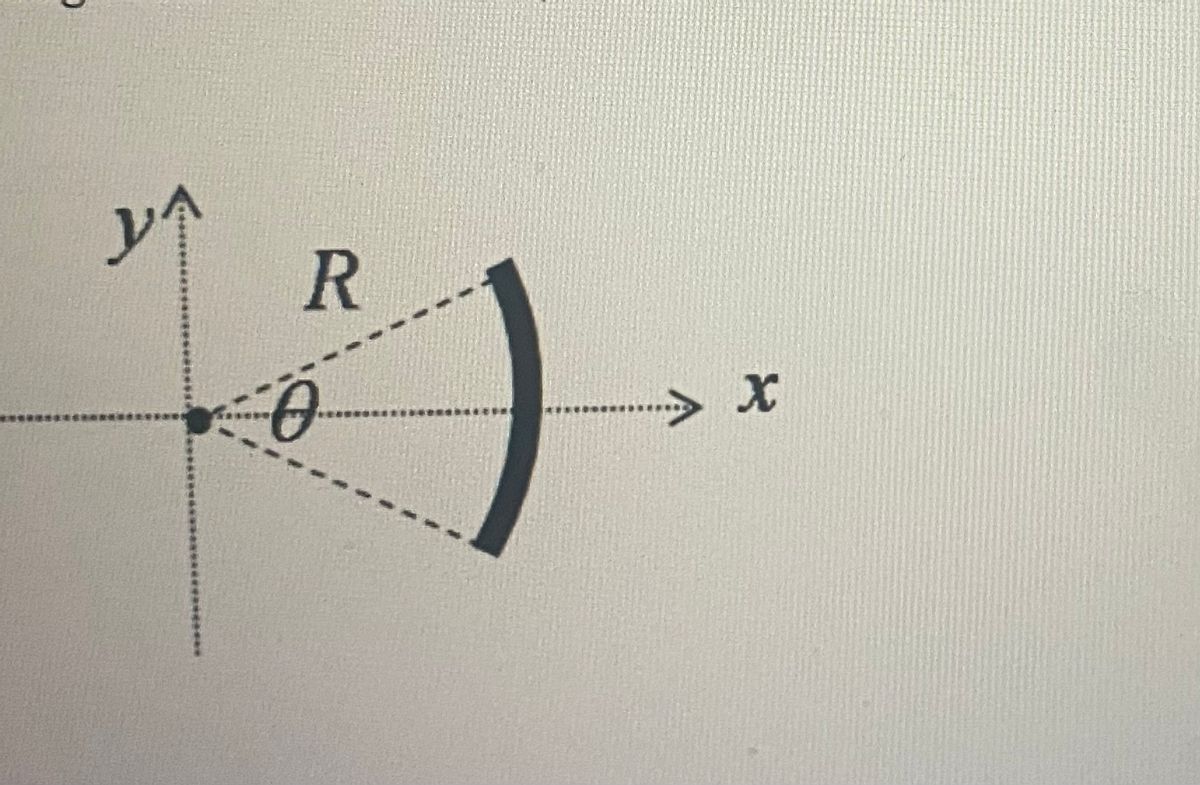

Transcribed Image Text:x
Ꮎ
ᎠᎪ
R
Expert Solution

This question has been solved!
Explore an expertly crafted, step-by-step solution for a thorough understanding of key concepts.

This is a popular solution

Trending nowThis is a popular solution!

Step by stepSolved in 3 steps with 3 images

Knowledge Booster


Learn more about
Need a deep-dive on the concept behind this application? Look no further. Learn more about this topic, physics and related others by exploring similar questions and additional content below.Similar questions
- A charged rod of total length 5.8 m lies centered on the x axis as shown (the L indicated in the picture is half of that number, meaning that L = 2.9 m). The rod has a charge density which varies according to λ=ax2 where a=−20.2 μC/m3. a) What is the total charge on the rod? b) What is the x component of the electric field at a point on the x axis a distance of D=4.2 m from the end of the rod? Use a negative sign for a field pointing in the -x direction.arrow_forwardThere is a +5C charge at the center of a hollow sphere made of a perfect conductor. The hollow sphere has a net charge of +2C, an inner radius of 0.5 m and an outer radius of 0.75 m. Calculate the electric field as a function of distance from the +5C charge and the charge on each surface of the hollow sphere.arrow_forwardThe figure below shows two lines of charge in cross-section coming out of the page. Each line of charge has a linear charge density of ±7.90 nC/cm and they are separated by a distance d = 23.0 cm. What is the magnitude of the electric field at the dot, a point y = 5.80 cm above the midpoint between the lines?arrow_forward
- Please please type the answer instead of writing, thanksarrow_forwardA small plastic ball of mass m = 1.50 g is suspended by a string of length L = 17.0 cm in a uniform electric field, as shown in the figure below. If the ball is in equilibrium when the string makes a ? = 17.0° angle with the vertical as indicated, what is the net charge on the ball? A ball of mass m is attached to a string of length L and suspended from the ceiling. The string makes an acute angle ? with the normal line from the ceiling, such that the string and ball are displaced to the right of the normal line. To the right of the string and ball, five parallel, evenly-spaced, identical arrows point to the right. The arrows are vertically stacked and labeled with E = 1.00 ✕ 103 N/C. To the left of the string and ball, x y-coordinate axes demonstrate that the +x-axis points to the right and the +y-axis points up.arrow_forwardA rod of length l = 5 m, is uniformly charged and has a total charge of 46 nC. What is the magnitude of the electric field (in N/C) at the point 'P' which lies along the axis of the rod and is 4.8 m from the center of the rod? E Parrow_forward
- There is a +5C charge at the center of a hollow sphere made of a perfect conductor. The hollow sphere has a net charge of +2C, an inner radius of 0.5 m and an outer radius of 0.75 m. Calculate the electric field as a function of distance from the +5C charge and the charge on each surface of the hollow sphere.arrow_forwardIn the figure a thin glass rod forms a semicircle of radius r = 5.94 cm. Charge is uniformly distributed along the rod, with +q = 4.76 pc in the upper half and -q = -4.76 pC in the lower half. What is the magnitude of the electric field at P, the center of the semicircle? Number i Units + Parrow_forwardIn the figure a nonconducting rod of length L = 8.39 cm has charge -q = -4.42 fC uniformly distributed along its length. (a) What is the linear charge density of the rod? What are the (b) magnitude and (c) direction (positive angle relative to the positive direction of the x axis) of the electric field produced at point P, at distance a = 12.7 cm from the rod? What is the electric field magnitude produced at distance a = 80 m by (d) the rod and (e) a particle of charge -q = -4.42 fC that replaces the rod?arrow_forward
arrow_back_ios
arrow_forward_ios
Recommended textbooks for you
- College PhysicsPhysicsISBN:9781305952300Author:Raymond A. Serway, Chris VuillePublisher:Cengage Learning
 University Physics (14th Edition)PhysicsISBN:9780133969290Author:Hugh D. Young, Roger A. FreedmanPublisher:PEARSON
 Introduction To Quantum MechanicsPhysicsISBN:9781107189638Author:Griffiths, David J., Schroeter, Darrell F.Publisher:Cambridge University Press
  Physics for Scientists and EngineersPhysicsISBN:9781337553278Author:Raymond A. Serway, John W. JewettPublisher:Cengage Learning
 Lecture- Tutorials for Introductory AstronomyPhysicsISBN:9780321820464Author:Edward E. Prather, Tim P. Slater, Jeff P. Adams, Gina BrissendenPublisher:Addison-Wesley
 College Physics: A Strategic Approach (4th Editio...PhysicsISBN:9780134609034Author:Randall D. Knight (Professor Emeritus), Brian Jones, Stuart FieldPublisher:PEARSON
College Physics
Physics
ISBN:9781305952300
Author:Raymond A. Serway, Chris Vuille
Publisher:Cengage Learning
University Physics (14th Edition)
Physics
ISBN:9780133969290
Author:Hugh D. Young, Roger A. Freedman
Publisher:PEARSON
Introduction To Quantum Mechanics
Physics
ISBN:9781107189638
Author:Griffiths, David J., Schroeter, Darrell F.
Publisher:Cambridge University Press
Physics for Scientists and Engineers
Physics
ISBN:9781337553278
Author:Raymond A. Serway, John W. Jewett
Publisher:Cengage Learning
Lecture- Tutorials for Introductory Astronomy
Physics
ISBN:9780321820464
Author:Edward E. Prather, Tim P. Slater, Jeff P. Adams, Gina Brissenden
Publisher:Addison-Wesley
College Physics: A Strategic Approach (4th Editio...
Physics
ISBN:9780134609034
Author:Randall D. Knight (Professor Emeritus), Brian Jones, Stuart Field
Publisher:PEARSON