


College Physics
11th Edition
ISBN: 9781305952300
Author: Raymond A. Serway, Chris Vuille
Publisher: Cengage Learning
expand_more
expand_more
format_list_bulleted

Related questions
Question
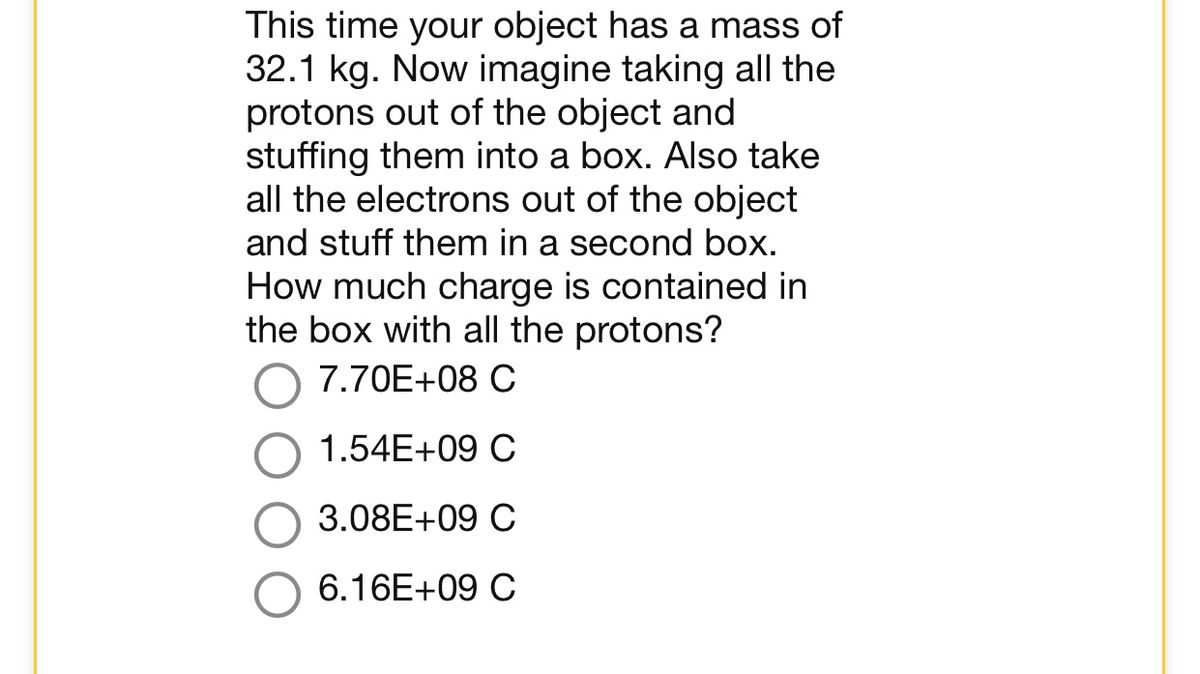

Transcribed Image Text:This time your object has a mass of
32.1 kg. Now imagine taking all the
protons out of the object and
stuffing them into a box. Also take
all the electrons out of the object
and stuff them in a second box.
How much charge is contained in
the box with all the protons?
7.70E+08 C
1.54E+09 C
3.08E+09 C
6.16E+09 C
Expert Solution

This question has been solved!
Explore an expertly crafted, step-by-step solution for a thorough understanding of key concepts.

This is a popular solution

Trending nowThis is a popular solution!

Step by stepSolved in 2 steps with 2 images

Knowledge Booster


Learn more about
Need a deep-dive on the concept behind this application? Look no further. Learn more about this topic, physics and related others by exploring similar questions and additional content below.Similar questions
- D only pleasearrow_forwardA proton is held at the positive plate parallel arrangement. The plates are 1.45 cm apart and the proton has a potential energyof 5.45 x 10^-18 Joules.a) What is the electric field strength?b) How much force is needed to hold the proton at the positive plate?c) If the proton is released, what will be its speed just before it strikes the negative plate?arrow_forwardThree identical point charges (+52 µC) are placed at the corners of an equilateral triangle that has (20 cm sides. How much work ( in units of J) is required to assemble this charge arrangement starting with each of the charges a very large distance from any of the other charges? Select one: A. 270.4 B. 365.0 C. 216.3 D. 135.2arrow_forward
- Find the charge on capacitor, C2 , in the diagram below if Vab=24.0 volts, C1=6.00uF, C2=3.00uF, and C3=10.0uF. a. 12 µC b. 24 µC c. 36 µC d. 48 µC e. 60 µCarrow_forward. A charge of +3.0 µC is distributed uniformly along the circumference of a circle with a radius of 20 cm. How much external energy is required to bring a charge of 25uC from infinity to the center of the circle? Select one: a. २.521 b. 8) C 3.375) 0. 2.53 e. 0.35)arrow_forwardhelp me pls!arrow_forward
- How much energy is stored by the electric field between two square plates, 9.1 cm on a side, separated by a 2.3-mm air gap? The charges on the plates are equal and opposite and of magnitude 15 nC. Express your answer using two significant figures and include the appropriate units. PE = Value Units Submit Request Answer * Previous Next 15:10 hp W 27/03/2022 2000 hp f6 4 f11 10 F12 f10 f7 II f5 f8 f9 insert prt sc ( 9- ) 0 & -backspa // 大 t6arrow_forwardTwo parallel plates have equal and opposite charges. When the space between the plates is evacuated, the electric field is E= 3.30×10⁵ V/m. When the space is filled with dielectric, the electric field is E= 2.50×10⁵ V/m. For related problem-solving tips and strategies, you may want to view a Video Tutor Solution of Energy density, both before and after the. What is the charge density on each surface of the dielectric? Express your answer in coulombs per meter squared. να ΑΣΦ ? |X| X•10" |oi| = C/m²arrow_forward8arrow_forward
- The work done by an external force to move a -8.60 μC charge from point a to point b is 1.90x10-³ J. Part A If the charge was started from rest and had 4.77x10⁻⁴ J of kinetic energy when it reached point b, what must be the potential difference between a and b? ——| ΑΣΦ Vb - V₂ = ? Varrow_forwardA proton (mass = 1.67 x 10⁻²⁷ kg, charge = 1.60 x 10⁻¹⁹ C) moves from %3D point A to point B under the influence of an electrostatic force only. At point A the proton moves with a speed of 50 km/s. At point B the speed of the proton is 87.8 km/s. Determine the potential difference VB-VA (in units of volts). Select one: O A. 20.41 O B. -42.81 OC. -27.18 OD. 2.15 E. 26.66arrow_forwardTwo plates with area 5.00 × 10-³ m² are separated by a distance of 4.80 × 10⁻⁴ m. If a charge of 3.40 × 10⁻⁸ ℃ is moved from one plate to the other, calculate the potential difference (voltage) between the two plates. Assume that the separation distance is small in comparison to the diameter of the plates.arrow_forward
arrow_back_ios
SEE MORE QUESTIONS
arrow_forward_ios
Recommended textbooks for you
- College PhysicsPhysicsISBN:9781305952300Author:Raymond A. Serway, Chris VuillePublisher:Cengage Learning
 University Physics (14th Edition)PhysicsISBN:9780133969290Author:Hugh D. Young, Roger A. FreedmanPublisher:PEARSON
 Introduction To Quantum MechanicsPhysicsISBN:9781107189638Author:Griffiths, David J., Schroeter, Darrell F.Publisher:Cambridge University Press
  Physics for Scientists and EngineersPhysicsISBN:9781337553278Author:Raymond A. Serway, John W. JewettPublisher:Cengage Learning
 Lecture- Tutorials for Introductory AstronomyPhysicsISBN:9780321820464Author:Edward E. Prather, Tim P. Slater, Jeff P. Adams, Gina BrissendenPublisher:Addison-Wesley
 College Physics: A Strategic Approach (4th Editio...PhysicsISBN:9780134609034Author:Randall D. Knight (Professor Emeritus), Brian Jones, Stuart FieldPublisher:PEARSON
College Physics
Physics
ISBN:9781305952300
Author:Raymond A. Serway, Chris Vuille
Publisher:Cengage Learning
University Physics (14th Edition)
Physics
ISBN:9780133969290
Author:Hugh D. Young, Roger A. Freedman
Publisher:PEARSON
Introduction To Quantum Mechanics
Physics
ISBN:9781107189638
Author:Griffiths, David J., Schroeter, Darrell F.
Publisher:Cambridge University Press
Physics for Scientists and Engineers
Physics
ISBN:9781337553278
Author:Raymond A. Serway, John W. Jewett
Publisher:Cengage Learning
Lecture- Tutorials for Introductory Astronomy
Physics
ISBN:9780321820464
Author:Edward E. Prather, Tim P. Slater, Jeff P. Adams, Gina Brissenden
Publisher:Addison-Wesley
College Physics: A Strategic Approach (4th Editio...
Physics
ISBN:9780134609034
Author:Randall D. Knight (Professor Emeritus), Brian Jones, Stuart Field
Publisher:PEARSON