


Elements Of Electromagnetics
7th Edition
ISBN: 9780190698614
Author: Sadiku, Matthew N. O.
Publisher: Oxford University Press
expand_more
expand_more
format_list_bulleted

Related questions
Question
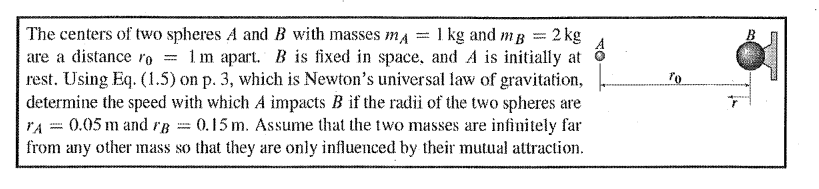

Transcribed Image Text:2 kg
The centers of two spheres A and B with masses mA 1 kg and mg
are a distance ro 1m apart. B is fixed in space, and A is initially at
rest. Using Eq. (1.5) on p. 3, which is Newton's universal law of gravitation,
determine the speed with which A impacts B if the radii of the two spheres are
A = 0.05 m and FB = 0.15 m. Assume that the two masses are infinitely far
from any other mass so that they are only influenced by their mutual attraction.
Το
Expert Solution

This question has been solved!
Explore an expertly crafted, step-by-step solution for a thorough understanding of key concepts.

Step by stepSolved in 2 steps

Knowledge Booster

Similar questions
- The 6-kg sphere and 4-kg block (shown in section) Fig.P3 are secured to the arm of negligible mass which rotates in the vertical plane about a horizontal axis at O. The 2-kg plug is released with initial velocity vo at A and falls into the recess in the block when the 2 kg arm has reached the horizontal position. An instant before engagement, the arm has an angular velocity 0o = 2 rad/s. CCW.What must be the initial velocity vo so that the angular velocity of the arm immediately after the plug has wedged itself in the block o =0.5rad/s. CW. 600 mm -300 mm- 6 kg 4 kg -500 mm Fig.P3arrow_forward2. (25) The small 2-kg block A slides down the curved path and passes the lowest point B with a speed of 4 m/s. If the radius of curvature of the path at B is 1.5 m, and the coefficient of friction between the block and path is 0.3, determine (a) the normal force exerted on the block by the path at B, and (b) the rate of change of speed at this point. Barrow_forward5.78arrow_forward
- A robot arm moves in the vertical plane so that the 0.14-kg cylinder P travels in a circle about point B, which is not moving. Know that arm BP starts from rest in a horizontal position and that the speed of Pincreases at a constant rate of 200 mm/s². 0.8 m Draw the free-body diagram of the cylinder P that is required to determine the force acting on the cylinder. (You must provide an answer before moving on to the next part.) 0.8 m P 1 Iarrow_forwardA 74 g ball B dropped from a height ho=1.9 m reaches a height h₂= 0.25 m after bouncing twice from identical 250-g plates. Plate A rests directly on hard ground, while plate Crests on a foam-rubber mat. ho B hy Determine the height h1 of the ball's first bounce. The height h1 of the ball's first bounce is m.arrow_forward- PLEASE HELP!!arrow_forward
- Figure below shows a system of pulley and two loads connected through two cables. The two loads have the same mass. The weight of the cylinder is equal to the combined weight of the loads (Wc=2W1). The system is released from rest. (a) Determine the magnitude and direction of the angular acceleration of the pulley, (b) Which cable will experience more tension, cable 1 or cable 2? Why? NOTE: The mass moment of inertia of a cylinder with a radius of R and a mass of m is determined using ½.m.R². L Pulley 1. ft 0.6 ft 1 Larrow_forwardA 50 Ib block A is attached to a wire that is wrapped around the shown flywheel of 30" radius and I = 12 ft-lb-s². The system is released from the rest. Neglect the effect of friction, determine (a) the acceleration of the block A, (b) the speed of the block A after it has moved 10 ft. Aarrow_forwardEXERCISE 2.53 Collar C is pushed along the guide bar defined by y= 2(1-0.25x²), where x and y have units of meters. The angular speed of arm AB that actuates the motion is the constant value = 20 rad/s, so = ct. Determine the forces exerted on the collar by arm AB and the guide bar at x = 1 m. The mass of the collar is 2 kg, and gravitational effects are ignorable. (Hint: use Cartesian and polar coordinates to solve the problem.)arrow_forward
arrow_back_ios
arrow_forward_ios
Recommended textbooks for you
- Elements Of ElectromagneticsMechanical EngineeringISBN:9780190698614Author:Sadiku, Matthew N. O.Publisher:Oxford University Press
 Mechanics of Materials (10th Edition)Mechanical EngineeringISBN:9780134319650Author:Russell C. HibbelerPublisher:PEARSON
 Thermodynamics: An Engineering ApproachMechanical EngineeringISBN:9781259822674Author:Yunus A. Cengel Dr., Michael A. BolesPublisher:McGraw-Hill Education
  Control Systems EngineeringMechanical EngineeringISBN:9781118170519Author:Norman S. NisePublisher:WILEY
 Mechanics of Materials (MindTap Course List)Mechanical EngineeringISBN:9781337093347Author:Barry J. Goodno, James M. GerePublisher:Cengage Learning
 Engineering Mechanics: StaticsMechanical EngineeringISBN:9781118807330Author:James L. Meriam, L. G. Kraige, J. N. BoltonPublisher:WILEY
Elements Of Electromagnetics
Mechanical Engineering
ISBN:9780190698614
Author:Sadiku, Matthew N. O.
Publisher:Oxford University Press
Mechanics of Materials (10th Edition)
Mechanical Engineering
ISBN:9780134319650
Author:Russell C. Hibbeler
Publisher:PEARSON
Thermodynamics: An Engineering Approach
Mechanical Engineering
ISBN:9781259822674
Author:Yunus A. Cengel Dr., Michael A. Boles
Publisher:McGraw-Hill Education
Control Systems Engineering
Mechanical Engineering
ISBN:9781118170519
Author:Norman S. Nise
Publisher:WILEY
Mechanics of Materials (MindTap Course List)
Mechanical Engineering
ISBN:9781337093347
Author:Barry J. Goodno, James M. Gere
Publisher:Cengage Learning
Engineering Mechanics: Statics
Mechanical Engineering
ISBN:9781118807330
Author:James L. Meriam, L. G. Kraige, J. N. Bolton
Publisher:WILEY