

Elements Of Electromagnetics
7th Edition
ISBN: 9780190698614
Author: Sadiku, Matthew N. O.
Publisher: Oxford University Press
expand_more
expand_more
format_list_bulleted

Related questions

Concept explainers
Question
A rock is thrown horizontally off a 100 m high-rise building as shown
in Figure Q4(a). It lands 95 m away. At what speed was it thrown?
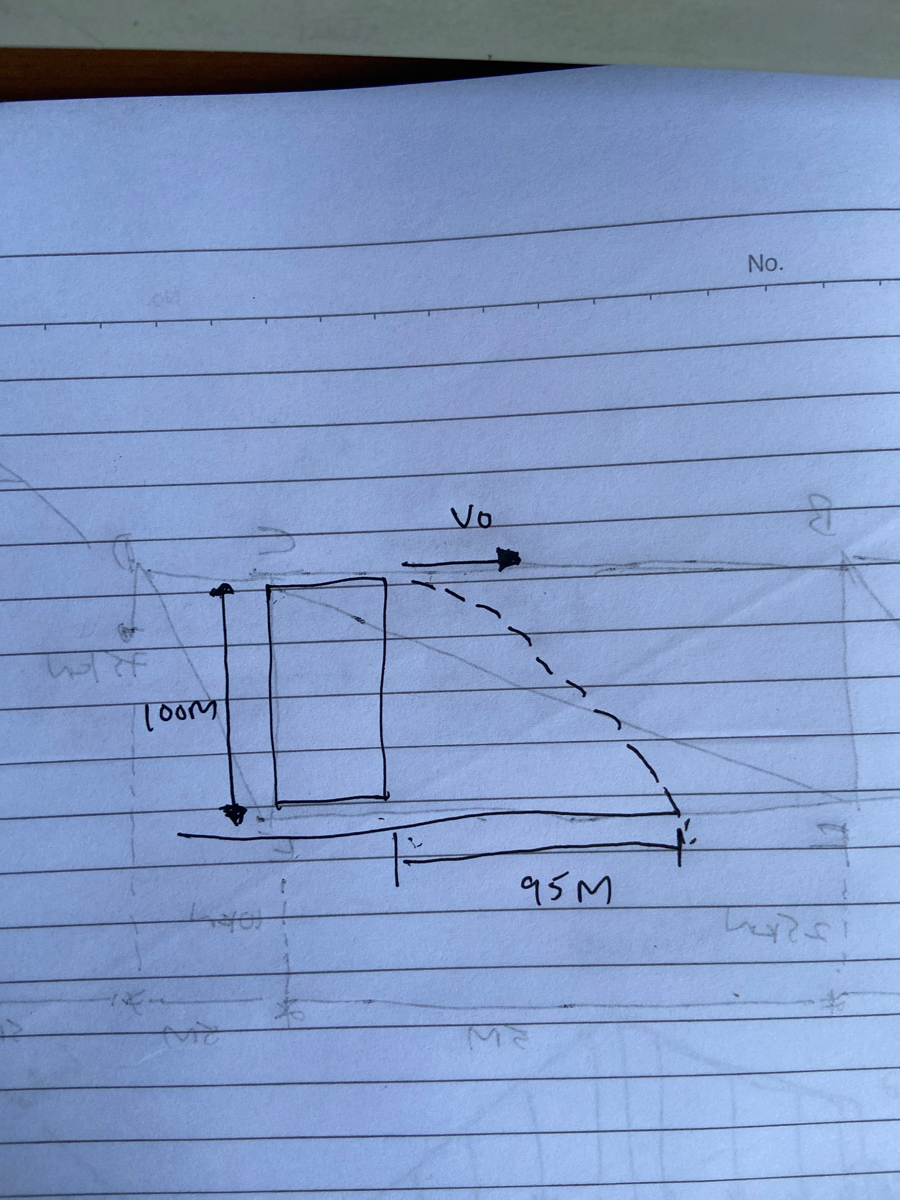

Transcribed Image Text:No.
Vo
री
95M
Expert Solution

This question has been solved!
Explore an expertly crafted, step-by-step solution for a thorough understanding of key concepts.

This is a popular solution

Trending nowThis is a popular solution!

Step by stepSolved in 2 steps

Knowledge Booster


Learn more about
Need a deep-dive on the concept behind this application? Look no further. Learn more about this topic, mechanical-engineering and related others by exploring similar questions and additional content below.Similar questions
- P3.8 For the mechanism shown in Figure P3.8, deter- O mine the linear velocity of point D using instanta- neous centers. = 2.5 in; ro.A = 1.0 in =D1.5 in; fo,c = 1.0 in; fo,0. "o,0, TAB = 2.5 in; ro,B =1.5 in; ro.c = 2.0 in Tcp = 1.0 in; rcE = 1.5 in; ro.E 0, = 45°; 0, = 5.0 rad/sec CCW %3D %3D = 2.0 in %3D %3D 3 4. PA 2. 02 O, O 1 1 9. DE Figure P3.8arrow_forwardIn a nutshell, a smaller rock is propelled into the air as a huge counterweight in the back falls down, effectively converting gravitational potential energy into kinetic energy for the rock and the weight. But, since the rock is smaller.. it is propelled at a much faster velocity! Let's say we wanted to hurl a 50 kg boulder at a castle wall 100 meters away. Our wooden structure for the trebuchet is 10 meters tall, so that is the maximum distance the counterweight can fall. Assuming the launch angle is a perfect 45 degrees, and the boulder is released from ground level, derive the needed mass of the counterweight that will give the boulder enough kinetic energy to reach the base of the castle walls. You may assume no energy is "lost" due to friction, and ALL the counterweight's gravitational potential energy is converted into the boulder's kinetic enerqy. (HINT: You will need to employ 2D kinematics to find the needed final velocity, then use that final velocity in an energy equation…arrow_forwardVP5.22.3 An aerobatic airplane flying at a constant 80.0 m/s makes a horizontal turn of radius 175 m. The pilot has mass 80.0 kg. (a) What is the bank angle of the airplane? (b) What is the pilot’s appar- ent weight during the turn? How many times greater than his actual weight is this?arrow_forward
Recommended textbooks for you
- Elements Of ElectromagneticsMechanical EngineeringISBN:9780190698614Author:Sadiku, Matthew N. O.Publisher:Oxford University Press
 Mechanics of Materials (10th Edition)Mechanical EngineeringISBN:9780134319650Author:Russell C. HibbelerPublisher:PEARSON
 Thermodynamics: An Engineering ApproachMechanical EngineeringISBN:9781259822674Author:Yunus A. Cengel Dr., Michael A. BolesPublisher:McGraw-Hill Education
  Control Systems EngineeringMechanical EngineeringISBN:9781118170519Author:Norman S. NisePublisher:WILEY
 Mechanics of Materials (MindTap Course List)Mechanical EngineeringISBN:9781337093347Author:Barry J. Goodno, James M. GerePublisher:Cengage Learning
 Engineering Mechanics: StaticsMechanical EngineeringISBN:9781118807330Author:James L. Meriam, L. G. Kraige, J. N. BoltonPublisher:WILEY
Elements Of Electromagnetics
Mechanical Engineering
ISBN:9780190698614
Author:Sadiku, Matthew N. O.
Publisher:Oxford University Press
Mechanics of Materials (10th Edition)
Mechanical Engineering
ISBN:9780134319650
Author:Russell C. Hibbeler
Publisher:PEARSON
Thermodynamics: An Engineering Approach
Mechanical Engineering
ISBN:9781259822674
Author:Yunus A. Cengel Dr., Michael A. Boles
Publisher:McGraw-Hill Education
Control Systems Engineering
Mechanical Engineering
ISBN:9781118170519
Author:Norman S. Nise
Publisher:WILEY
Mechanics of Materials (MindTap Course List)
Mechanical Engineering
ISBN:9781337093347
Author:Barry J. Goodno, James M. Gere
Publisher:Cengage Learning
Engineering Mechanics: Statics
Mechanical Engineering
ISBN:9781118807330
Author:James L. Meriam, L. G. Kraige, J. N. Bolton
Publisher:WILEY