

Chemistry
10th Edition
ISBN: 9781305957404
Author: Steven S. Zumdahl, Susan A. Zumdahl, Donald J. DeCoste
Publisher: Cengage Learning
expand_more
expand_more
format_list_bulleted

Related questions

Concept explainers
Question
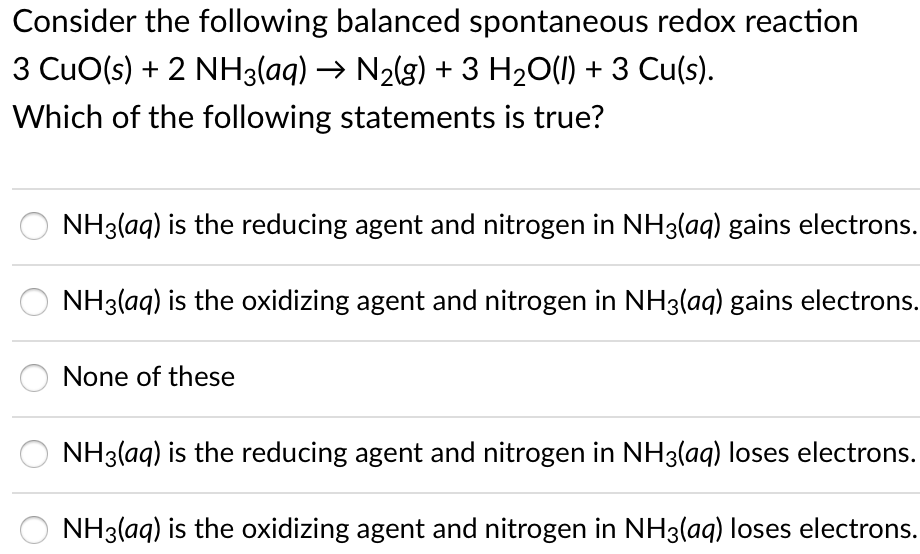

Transcribed Image Text:Consider the following balanced spontaneous redox reaction
3 CuO(s) + 2 NH3(aq) → N2(g) + 3 H20(1) + 3 Cu(s).
Which of the following statements is true?
NH3(aq) is the reducing agent and nitrogen in NH3(aq) gains electrons.
NH3(aq) is the oxidizing agent and nitrogen in NH3(aq) gains electrons.
None of these
NH3(aq) is the reducing agent and nitrogen in NH3(aq) loses electrons.
NH3(aq) is the oxidizing agent and nitrogen in NH3(aq) loses electrons.
Expert Solution

This question has been solved!
Explore an expertly crafted, step-by-step solution for a thorough understanding of key concepts.

This is a popular solution

Trending nowThis is a popular solution!

Step by stepSolved in 2 steps

Knowledge Booster

Learn more about
Need a deep-dive on the concept behind this application? Look no further. Learn more about this topic, chemistry and related others by exploring similar questions and additional content below.Similar questions
- Write a balanced net ionic equation for a redox reaction that results in the formation of potassium chloride. (Assume that potassium chloride is not a starting material, and assume the reaction takes place in aqueous solution.) X, Не (aq), 2K(ag)+Cl, (aq) KCI(aq)arrow_forwardWrite a balanced redox reaction for the reaction shown below. Cr(s) │ Cr+3 (aq) ║ Fe+2(aq) │ Fe(s)arrow_forwardFor the following redox reaction, write a balanced equation for the whole reaction and include the states of matter: MnO4−(aq) + Cl−(aq) → Mn2+(aq) + Cl2(g) (in acidic solution)arrow_forward
- Given the following half-reactions, 2 103 (aq) + 12H*(aq) + 10 e → 12(s) + 6H2O Fe2* (aq) → Fe3* (aq) + e" write the balanced overall reaction. 2103 - (aq) + 12 H* (aq) + Fe 2* (aq) → Fel2 (s) + 6 H2O o 2 103 (aq) + 10 Fe²* (aq) → l2 (s) + 10 Fe³+ (aq) 2 103 - (aq) + 12 H* (aq) + Fe 2* (aq) → 12 (s) + Fe3+ (aq) + 6 H20 2 103 - (aq) + 12 H* (aq) + 10 Fe 2* (aq) → 12 (s) + 10 Fe3+ (aq) + 6 H20arrow_forwardIn the balanced redox reaction: 2 Cu(s) + S(s) > Cu 2S(s); how many electrons are gained or lost by each copper atom?arrow_forwardComplete and balance the following redox equation in basic solution. Br2(l) + Al(OH)4–(aq) ⟶ Br–(aq) + AlO42–(aq)arrow_forward
- Consider the unbalanced redox reaction shown below: KClO3 (aq) + HBr (aq) → Br2 (l) + H2O (l) + KCl (aq) What is the oxidizing agent?arrow_forwardWhich reaction(s) can be identified as a redox reaction? CuO(s) + H₂SO4(aq) → CuSO4(aq) + H₂O(1) Cu(NO3)2(aq) + 2NaOH(aq) -> A →→ Cu(OH)₂(s) + 2NaNO3(aq) Cu(OH)2(s) CuO(s) + H₂O(g) CuSO4(aq) +Zn(s) → ZnSO4(aq) + Cu(s) Cu(s)+ 4HNO3(aq) - Cu(NO3)2(aq) + 2NO₂(aq) + 2H₂O(1)arrow_forwardWrite balanced half-reactions for the following redox reaction:arrow_forward
- The hydroperoxide ion, HO2–(aq), reacts with permanganate ion, MnO4–(aq) to produce MnO2(s) and oxygen gas. Balance the equation for the oxidation of hydroperoxide ion to O2(g) by permanganate ion in a basic solution.arrow_forwarda) Which Species Oxidized? b) What is the balance redox reaction?arrow_forward
arrow_back_ios
arrow_forward_ios
Recommended textbooks for you
- ChemistryChemistryISBN:9781305957404Author:Steven S. Zumdahl, Susan A. Zumdahl, Donald J. DeCostePublisher:Cengage Learning
 ChemistryChemistryISBN:9781259911156Author:Raymond Chang Dr., Jason Overby ProfessorPublisher:McGraw-Hill Education
 Principles of Instrumental AnalysisChemistryISBN:9781305577213Author:Douglas A. Skoog, F. James Holler, Stanley R. CrouchPublisher:Cengage Learning
  Organic ChemistryChemistryISBN:9780078021558Author:Janice Gorzynski Smith Dr.Publisher:McGraw-Hill Education
 Chemistry: Principles and ReactionsChemistryISBN:9781305079373Author:William L. Masterton, Cecile N. HurleyPublisher:Cengage Learning
 Elementary Principles of Chemical Processes, Bind...ChemistryISBN:9781118431221Author:Richard M. Felder, Ronald W. Rousseau, Lisa G. BullardPublisher:WILEY
Chemistry
Chemistry
ISBN:9781305957404
Author:Steven S. Zumdahl, Susan A. Zumdahl, Donald J. DeCoste
Publisher:Cengage Learning
Chemistry
Chemistry
ISBN:9781259911156
Author:Raymond Chang Dr., Jason Overby Professor
Publisher:McGraw-Hill Education
Principles of Instrumental Analysis
Chemistry
ISBN:9781305577213
Author:Douglas A. Skoog, F. James Holler, Stanley R. Crouch
Publisher:Cengage Learning
Organic Chemistry
Chemistry
ISBN:9780078021558
Author:Janice Gorzynski Smith Dr.
Publisher:McGraw-Hill Education
Chemistry: Principles and Reactions
Chemistry
ISBN:9781305079373
Author:William L. Masterton, Cecile N. Hurley
Publisher:Cengage Learning
Elementary Principles of Chemical Processes, Bind...
Chemistry
ISBN:9781118431221
Author:Richard M. Felder, Ronald W. Rousseau, Lisa G. Bullard
Publisher:WILEY