


(a)

To show : the salary equation is given by
Explanation of Solution
Given information :
The initial salary is
Formula needed :
Salary increases per year and function is given by
Proof :
From initial to first year, the salary is
From first to second year, the salary is
From second to third year, the salary is
From third to fourth year, the salary is
Hence, for
(b)
To graph : The salary function
Explanation of Solution
Given information :
The salary function is given by
Graph :
So, the salary function for first four year is
Thus, the graph is
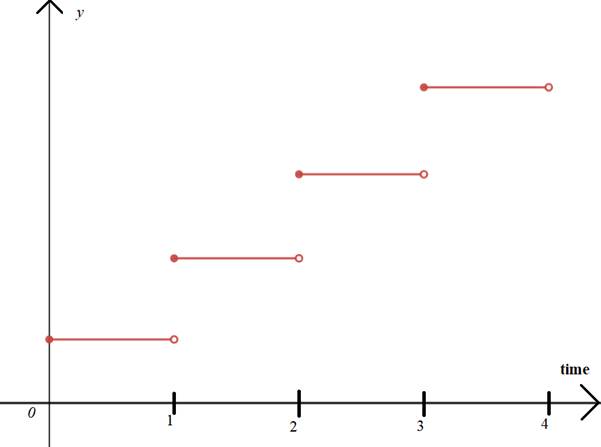
Interpretation :
The function is continuous in the interval
Chapter 1 Solutions
Advanced Placement Calculus Graphical Numerical Algebraic Sixth Edition High School Binding Copyright 2020
- Sketch the graph of the polar equation: r=2+3 sin 3xarrow_forwardPositive, negative, or zero?arrow_forwardUnread DISCUSSION - Do We Really Need the Chain Rule?? Reply Our favorite little Calculus cat, Pucky, is back! He's been watching our online sessions and seeing our homework this week. And through all the rules and methods of this week, Pucky has just one problem. Pucky doesn't believe in the Chain Rule. He doesn't think we really need it. Pucky thinks that if we have f (x) should just have to use the power rule to find that f'(x)=2(x²+1)=2(x² + 1) = (x²+1)² then we For this discussion, write a post that briefly explains to Pucky why that derivative is incorrect and why we need to use the Chain Rule here. Don't just quote rules or theorems though, remember Pucky has already read the section and those rules and theorems make him growl and hiss. Try to come up with other explanations or reasons why Pucky's derivative is wrong beyond just "You need to use the Chain Rule". Help Pucky to realize that the Chain Rule is important and necessary and that even though he might prefer the Chain…arrow_forward
- Question 8 1 pt 1 Details If (t) defines a smooth curve C on [0,1] such that 7(0) = and 7(1) , then the arclength of C over the interval [0,1] cannot be less than 3. True False Question 9 Evaluate the limit, or type "DNE" if the limit Does Not Exist: lim 9216-9y16 (zy) (1,1) 328-3y³ Question 10 Evaluate the limit, or type "DNE" if the limit Does Not Exist: 1 pt 1 Details 1 pt 1 Details lim - zy = (x,y) (3,3)√√√√y Question 11 1 pt 1 Details Find the differential of the function f(x, y) = −6x² - 4xy – 9y² at the point (1, 3) using Az = 0.3 and Ay = -0.1. dx = Now find A and compare it to your answer above A== Question 12 1 pt 1 Details Find the differential of the function f(x, y) = 3re at the point (5, 3) using Ax = 0.05 and Ay = -0.1 dx = Now find Ax and compare it to your answer above Ax=arrow_forwardQuestion 1 Evaluate the limit. Note: two 'o's make infinity (oo). lim (3e, 20 sin (-3t) t ,(t -2)³) = 1 pt 1 Details Question 2 1 pt 1 Details Answer the following True or False: If **(t) is a vector valued function then the graph of (t) satisfies the vertical line test. True False Question 3 Find (t), given (t) = (-3sin (3t), 4e, cos (-2t)). (t)= Question 4 Find the second derivative of the vector-valued function F(t)=(3t+5sin (t)) + (2t+ 3cos (t)); "(t)=-5i sin(t) - 3j cos(t) Question 5 Find the arc length (s) of the curve (t): = Question 6 1 pt 1 Details 1 pt 1 Details 1 pt 1 Details (-2-1, 23/26,2+3/23) for 0 ≤t≤2 Find the curvature of the curve (t) = (5+t, 3-2t, -4- 2t) at the point t = 10. Question 7 5 Find the curvature of the curve (t) = (5 cost, 1, 3+ sint) at the point t = 6 1 pt 1 Details 1 pt 1 Detailsarrow_forwardQuestion 13 z = ext Let w(x, y, z) = x² + y² + z² where x = sin (7t), y = cos (5t), z = 6 dw dt Calculate by first finding dx dy dt' dt dz & and using the chain rule. dt dx || dt dy- dt dz dt Now use the chain rule to calculate the following: dw dt Question 14 Let -4x²-18xy - 20y²+32x+67y - 39 = 0. Use partial derivatives to calculate dy da at the point (-1,3). dy dx (-1,3) = 1 pt 1 Details 1 pt 1 Details Question 15 - 1 pt 1 Details For the function f(x, y) = −4x² — 5xy – 5y²-x-3y-2, find a unit tangent vector to the level curve at the point (4,-2) that has a positive a component. Round your numbers to four decimal places.arrow_forward
- 00:46 't Today 00:46 All Photos TUNICS UTT 79 apris DICIT 12 There are three conditions in which limits do not exist. Pick two of them, and explain each condition in complete sentences, in your own w hich limits do not e ach condition in co i 闫arrow_forwardQuestion 1 2 pts Let S = ∞ n=1 an be an infinite series such that the nth partial sum is Sn = 7 8 n² If necessary, round your answers to the following questions to two decimal places. 10 A. What is the value of Σ n=1 an? 16 B. What is the value of Σ an? n=4 C. What is the value of a3? D. Find the sum 1M8 n=1 Anarrow_forward☐ Question 1 2 pts Compute the partial sums s2, S4, and så for the series. 5 5 5 5+ + + + 22 32 42 Round your answers to two decimal places. S2 = S4 = S6 =arrow_forward
 Calculus: Early TranscendentalsCalculusISBN:9781285741550Author:James StewartPublisher:Cengage Learning
 Thomas' Calculus (14th Edition)CalculusISBN:9780134438986Author:Joel R. Hass, Christopher E. Heil, Maurice D. WeirPublisher:PEARSON
 Calculus: Early Transcendentals (3rd Edition)CalculusISBN:9780134763644Author:William L. Briggs, Lyle Cochran, Bernard Gillett, Eric SchulzPublisher:PEARSON
 Calculus: Early TranscendentalsCalculusISBN:9781319050740Author:Jon Rogawski, Colin Adams, Robert FranzosaPublisher:W. H. Freeman
 Calculus: Early Transcendental FunctionsCalculusISBN:9781337552516Author:Ron Larson, Bruce H. EdwardsPublisher:Cengage Learning