

Videos

a.

Graph the entered equations and describe the graph.
Answer to Problem 59E
Explanation of Solution
Given information:
With a graphing utility in radian and parametric modes, enter the equations
Graph the entered equations and describe the graph.
Calculation:
Consider the given equation
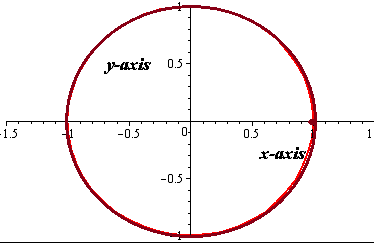
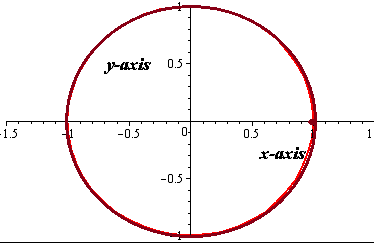
We get the circle with centre
Given conditions,
Represents the parametric form of equation of circle,
Hence, the plot is.
b.
What do the
Answer to Problem 59E
Explanation of Solution
Given information:
With a graphing utility in radian and parametric modes, enter the equations
Use the trace feature to move the cursor around the graph. What do the
Calculation:
Use the trace feature to move the cursor around the graph we get the vales
Hence,
c.
What are the least and greatest values of
Answer to Problem 59E
Explanation of Solution
Given information:
With a graphing utility in radian and parametric modes, enter the equations
What are the least and greatest values of
Calculation:
Hence the values of
Chapter 4 Solutions
Precalculus with Limits (MindTap Course List)

- Find the product solutions to the partial differential equation uxx + ut = 0arrow_forwarda) Find the eigenvalues and eigenfunctions of the boudary-value problem. x2y" + xy' + lambda(y) = 0 y(1) = 0, y(3) = 0 (Assume x and y are on a finite domaine) b) Put the differential equation in self-adjoint form c) Give an orthogogonality relation d) Verify that your orthogonality relation is valid.arrow_forwardDISCUSSION Whose Rule Was It?? This week's discussion focuses on another of the historical oddities that Calculus has to offer. It seems like a pretty simple question to ask "Who discovered L'Hopital's Rule?" Easy right, especially once we're told L'Hopital was the name of a French mathematician from the late 1600s. Slam dunk, no problem answer, right? (actually, people can't even agree if it's "L'Hopital" or "L'Hospital" so maybe this won't be as easy as we were hoping) Nope, not so much. The history behind the rule is quite fascinating and gives an interesting glimpse into the way mathematics was done back in the 1600s. For this discussion, we want to look into the history of how this famous rule was developed. See what you can find online about L'Hopital's Rule and the following two questions: 1. Who discovered L'Hopital's Rule? 2. If it wasn't L'Hopital, why it is called "L'Hopital's Rule"? Just like the Who Actually "Invented" Calculus? discussion from a couple weeks ago, entire…arrow_forward
- Please solve and show all work. Thank you.arrow_forwardPlease solve and show all work. Thank you.arrow_forwardPosted Apr 3 1:44pm | Last edited Apr 3 1:51pm DISCUSSION - Absolute Extrema in the "Real World" This will probably be one of the easier "real world" discussion posts we do since it's about maximums and minimums and you probably already have a good sense of why those are important! However, as we begin Chapter 4 we see that we have to do a lot of work to find maximums and minimums of functions. So I suppose it would be a good time to ask: What good is knowing the absolute max and min of a function? We probably can think of reasons to know maximums and minimums in general, but why would we want to know the absolute extrema for some graph? We have to do a lot of work for it (find the derivative, find the critical points, test the critical and end points) so it had better be worth it in the end! For this discussion, go out into the wilds of the internet and look around for some examples of how knowing the absolute extrema of a function can be useful in real-life situations. As before, you…arrow_forward
- DISCUSSION - Absolute Extrema in the "Real World" This will probably be one of the easier "real world" discussion posts we do since it's about maximums and minimums and you probably already have a good sense of why those are important! However, as we begin Chapter 4 we see that we have to do a lot of work to find maximums and minimums of functions. So I suppose it would be a good time to ask: What good is knowing the absolute max and min of a function? We probably can think of reasons to know maximums and minimums in general, but why would we want to know the absolute extrema for some graph? We have to do a lot of work for it (find the derivative, find the critical points, test the critical and end points) so it had better be worth it in the end! For this discussion, go out into the wilds of the internet and look around for some examples of how knowing the absolute extrema of a function can be useful in real-life situations. As before, you may want to choose something from your…arrow_forwardFind the curl of the vector field = (2y cos(x), 6x sin(y), 0). curl F =arrow_forwardUse the circulation form of Green's Theorem to calculate تھ F. dr where F(x, y) = (7(x² + y²), x² + y²), and C follows the graph of y = x³ from (1, 1) → (2,8) and then follows the line segment from (2, 8) → (1, 1).arrow_forward
 Calculus: Early TranscendentalsCalculusISBN:9781285741550Author:James StewartPublisher:Cengage Learning
 Thomas' Calculus (14th Edition)CalculusISBN:9780134438986Author:Joel R. Hass, Christopher E. Heil, Maurice D. WeirPublisher:PEARSON
 Calculus: Early Transcendentals (3rd Edition)CalculusISBN:9780134763644Author:William L. Briggs, Lyle Cochran, Bernard Gillett, Eric SchulzPublisher:PEARSON
 Calculus: Early TranscendentalsCalculusISBN:9781319050740Author:Jon Rogawski, Colin Adams, Robert FranzosaPublisher:W. H. Freeman
 Calculus: Early Transcendental FunctionsCalculusISBN:9781337552516Author:Ron Larson, Bruce H. EdwardsPublisher:Cengage Learning