

Concept explainers

Videos


To calculate
Answer to Problem 65E
Explanation of Solution
Given information:
The given function is
Calculation :
Take the derivative of the function
Use Newton’s method
Using
Therefore,
Since
The graph of above conditions
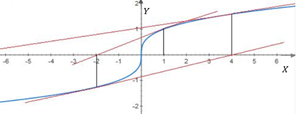
As can be seen from the graph, the tangent have lower and lower absolute slopes, so their intersections become further and further.
Chapter 5 Solutions
Calculus: Graphical, Numerical, Algebraic: Solutions Manual
Additional Math Textbook Solutions
Calculus: Early Transcendentals (2nd Edition)
Elementary Statistics: Picturing the World (7th Edition)
University Calculus: Early Transcendentals (4th Edition)
Elementary Statistics
Algebra and Trigonometry (6th Edition)
A First Course in Probability (10th Edition)

- 10 Replies DISCUSSION - Pucky's Undefined Area 口: He's back!! (and you can tell from this week's picture he's super excited about it) This week, Pucky is trying his paw at integration and... well he's maybe having a little bit of trouble with it. He's trying to integrate using u- substitution but it isn't going so well. Pucky wants to find the area under the curve f(x)= x (x²+1) from x = 0 to x = 1. Pucky knows that the definite integral can do that, so he sets up the integral 1 3 Reply 1 X dx -dr = " = (x²+1) dz and gets to work. (x²+1) Since there is an inside function, Pucky is going to try a u-substitution and let u 21. That would make du = 2xdx and dx = he substitutes those into the integral, it becomes du and when 2x du 1 хи = 2x 2 1 1 1 0 น du. Pucky then evaluates that integral as: 1 -2u ' u ³ du = ½ (−2 − ) = - (+)-(+) =- But this gives an undefined answer! Pucky has looked at the graph and knows that there is an actual defined area. So this result sends him into yet another…arrow_forwardReplies, 4 Unread DISCUSSION - Pucky's Undefined Area He's back!! (and you can tell from this week's picture he's super excited about it) This week, Pucky is trying his paw at integration and... well he's maybe having a little bit of trouble with it. He's trying to integrate using u- substitution but it isn't going so well. Pucky wants to find the area under the curve f(x) = from x = 0 to x = 1. Pucky knows that X (x² + 1) the definite integral can do that, so he sets up the integral Reply 1 C dx 3 (x2+ 1) 0 =S²x²(x² + 1) 3 dx and gets to work. Since there is an inside function, Pucky is going to try a u-substitution and let ux²+1. That would make du =2xdx and dx = he substitutes those into the integral, it becomes du and when 2x 1 du 1 хи udu. Pucky then evaluates that integral as: 2x 2 0 == 1½" u ³ du = ( − 2 + ) - - (+)-(+) 2 0 2u But this gives an undefined answer! Pucky has looked at the graph and knows that there is an actual defined area. So this result sends him into yet…arrow_forward18 Replies, 18 Unread DISCUSSION - Areas Under Curves in the "Real World" This is another in our "real-world" series of discussion topics. We've done this before with limits and derivatives, but this week we encounter a new Calculus object we want to look into: what good are areas under curves? We know that we can find an area under a curve using a definite integral and we'll see at the end of this week's material that we can even use anti-derivatives to help us find areas under curves. That's great... but why would we bother to find an area under a curve? What purpose could there be in finding out how much space is below a graph?? For this discussion, once again go out into the wilds of the internet and look around for some examples of how these areas under curves can be used in real-life situations. Then create a discussion post letting us know the most interesting examples that you can find or which professions might use these areas a whole bunch (with links so we can look it up and…arrow_forward
 Calculus: Early TranscendentalsCalculusISBN:9781285741550Author:James StewartPublisher:Cengage Learning
 Thomas' Calculus (14th Edition)CalculusISBN:9780134438986Author:Joel R. Hass, Christopher E. Heil, Maurice D. WeirPublisher:PEARSON
 Calculus: Early Transcendentals (3rd Edition)CalculusISBN:9780134763644Author:William L. Briggs, Lyle Cochran, Bernard Gillett, Eric SchulzPublisher:PEARSON
 Calculus: Early TranscendentalsCalculusISBN:9781319050740Author:Jon Rogawski, Colin Adams, Robert FranzosaPublisher:W. H. Freeman
 Calculus: Early Transcendental FunctionsCalculusISBN:9781337552516Author:Ron Larson, Bruce H. EdwardsPublisher:Cengage Learning