


Concept explainers

(a)

The minimum speed of the swing with which Jane must begin her swing to just make it to the other side.
Answer to Problem 8.81CP
The minimum speed of the swing with which Jane must begin her swing to just make it to the other side is
Explanation of Solution
Given info: The mass of Jane is
The diagram is shown below.
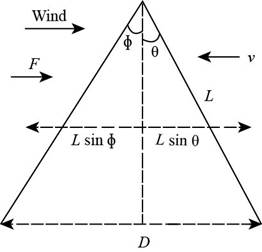
Figure I
From the figure, the width of the river is,
Here,
Rearrange the above formula for
Substitute
Thus, the value of
The formula to calculate the initial kinetic energy of Jane is,
Here,
Thus, the initial kinetic energy of Jane is
The formula to calculate the final kinetic energy of Jane is,
Here,
Substitute
Thus, the final kinetic energy of the Jane is
The formula to calculate the initial gravitational potential energy is,
Here,
Thus, the initial gravitational potential energy is
The formula to calculate the final gravitational potential energy is,
Here,
Thus the final potential energy of the car is
The formula to calculate the initial work done of the wind due to constant force is,
Here,
Substitute
Thus, the initial work done of the wind is
The formula to calculate the law of conservation of energy to the total system is,
Here,
Substitute
Substitute
Conclusion:
Therefore, the minimum speed of the swing that must Jane begin her swing to just make it to the other side is
(b)
The minimum speed of the swing at the beginning.
Answer to Problem 8.81CP
The minimum speed of the swing at the beginning is
Explanation of Solution
Given info: The mass of Jane is
The formula to calculate the combined mass is,
Here,
Substitute
The formula to calculate the initial kinetic energy is,
Here,
Thus, the initial kinetic energy is
The formula to calculate the final kinetic energy of Jane is,
Here,
Substitute
Thus, the final kinetic energy is
The formula to calculate the initial gravitational potential energy is,
Here,
Thus, the initial gravitational potential energy is
The formula to calculate the final gravitational potential energy is,
Here,
Thus the final potential energy of the car is
The formula to calculate the initial work done of the wind due to constant force is,
Here,
Substitute
Thus, the initial work done of the wind is
The formula to calculate the law of conservation of energy to the total system is,
Here,
Substitute
Substitute
Conclusion:
Therefore, the minimum speed of the swing at the beginning is
Want to see more full solutions like this?
Chapter 8 Solutions
EBK PHYSICS:F/SCI.+ENGRS.,TECH.UPDATED

- The Compton effect demonstrates the:A) Wave nature of lightB) Particle nature of lightC) Diffraction of lightD) Interference of lightarrow_forwardIn nuclear physics, the binding energy of a nucleus is due to:A) Gravitational forceB) Strong nuclear forceC) Weak forceD) Electromagnetic forcearrow_forwardWhich law explains blackbody radiation?A) Planck’s lawB) Newton’s lawC) Coulomb’s lawD) Faraday’s lawarrow_forward
- The Fermi–Dirac distribution is applicable to:A) BosonsB) FermionsC) PhotonsD) Classical particlesarrow_forwardWhich distribution describes photons in thermal equilibrium?A) Maxwell–BoltzmannB) Bose–EinsteinC) Fermi–DiracD) Poissonarrow_forwardThe Laplacian operator is represented by:A) ∇B) ∇×C) ∇·D) ∇²arrow_forward
- The partition function in statistical mechanics is used to calculate:A) Entropy onlyB) Energy onlyC) Thermodynamic quantitiesD) Pressure onlyarrow_forwardThe Lorentz force acting on a charge q moving with velocity v in magnetic field B is:A) qEB) q(v×B)C) q(v·B)D) qB²arrow_forwardThe unit of magnetic vector potential is:A) TeslaB) Weber/mC) Tesla·meterD) Weberarrow_forward
- Which particle mediates the electromagnetic force?A) PhotonB) GluonC) W bosonD) Z bosonarrow_forwardThe ground state energy of a particle in a one-dimensional infinite potential well of width L is proportional to:A) LB) L²C) 1/LD) 1/L²arrow_forwardThe operator for kinetic energy in quantum mechanics is:A) −ħ²/2m ∇²B) ħ²/2m ∇²C) −ħ² ∇²D) ħ² ∇²arrow_forward
 Principles of Physics: A Calculus-Based TextPhysicsISBN:9781133104261Author:Raymond A. Serway, John W. JewettPublisher:Cengage Learning
 Physics for Scientists and Engineers: Foundations...PhysicsISBN:9781133939146Author:Katz, Debora M.Publisher:Cengage Learning
 College PhysicsPhysicsISBN:9781285737027Author:Raymond A. Serway, Chris VuillePublisher:Cengage Learning
 Physics for Scientists and Engineers with Modern ...PhysicsISBN:9781337553292Author:Raymond A. Serway, John W. JewettPublisher:Cengage Learning
 College PhysicsPhysicsISBN:9781938168000Author:Paul Peter Urone, Roger HinrichsPublisher:OpenStax College
 Physics for Scientists and Engineers, Technology ...PhysicsISBN:9781305116399Author:Raymond A. Serway, John W. JewettPublisher:Cengage Learning