

Chemistry
10th Edition
ISBN: 9781305957404
Author: Steven S. Zumdahl, Susan A. Zumdahl, Donald J. DeCoste
Publisher: Cengage Learning
expand_more
expand_more
format_list_bulleted

Related questions

Concept explainers
Question
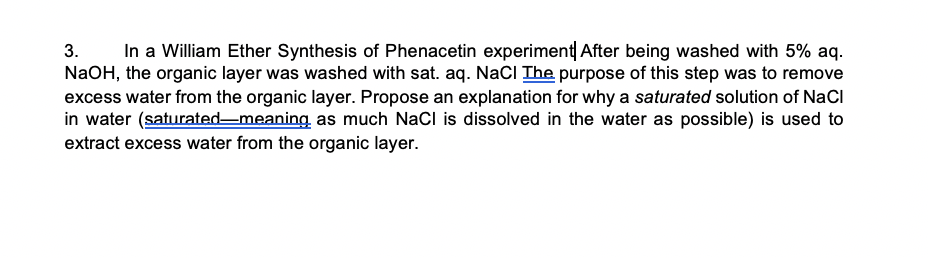

Transcribed Image Text:In a William Ether Synthesis of Phenacetin experiment After being washed with 5% aq.
NaOH, the organic layer was washed with sat. aq. NaCI The purpose of this step was to remove
excess water from the organic layer. Propose an explanation for why a saturated solution of NaCl
in water (saturated-meaning as much NaCl is dissolved in the water as possible) is used to
extract excess water from the organic layer.
3.
Expert Solution

This question has been solved!
Explore an expertly crafted, step-by-step solution for a thorough understanding of key concepts.

This is a popular solution

Trending nowThis is a popular solution!

Step by stepSolved in 2 steps

Knowledge Booster


Learn more about
Need a deep-dive on the concept behind this application? Look no further. Learn more about this topic, chemistry and related others by exploring similar questions and additional content below.Similar questions
- What is the ratio of benzaldehyde to thiamine hydrochloride used in this reaction? Why are we not using a full equivalent of this reagent?arrow_forward1. Propose a detailed stepwise mechanism, using curved arrow notation, for the following. H+ H a. b. H₂O, heat 1. LiAlH4 (xs) 2. H₂O OH H-N H 2. In the synthesis of peptides, carboxylic acids are condensed with amines in the present of a reagent such as dicyclohexylcarbodiimide (DCC) [Section 25.6]. a. Propose a mechanism for the following, using curved arrow notation. ° DCC H₂N H₂N OH OH H₂N glycine glycine OH Янзон gly-glyarrow_forwardWhat will the organic product of the following reaction be? Br NH₂ D). ii) base/basisarrow_forward
- The reaction of a nitrile with an alcohol in the presence of a strong acid forms an N-substituted amide. This reaction, known as the Ritter reaction, doesnot work with primary alcohols. a. Why does the Ritter reaction not work with primary alcohols? b. Provide an explanation for why an amide is less susceptible to nucleophilic attack than its corresponding ester.arrow_forwardWhich approach is SAFEST for the synthesis of the following ester: معه a. C. d. + CH₂OH b. ང་ཐིག་, - san ““ - OH ... + CH₂OH A OA OB ос OD + CH₂CH₂CH₂OHarrow_forwardPlease help me with both of these problems, they are the same question its just a two-part, I really want to study so please helparrow_forward
- SYNTHESIS OF BENZOIC ACID FROM BASIC HYDROLYSIS OF BENZONITRILE 2. Is the hydrolysis of benzonitrile to benzoic acid carried out in today's experiment acidic or basic? Briefly explain your answer. 4. Which of the following species is soluble in water and which is not? How are these properties used in the experiment? HO. Benzoato de sodio Acido benzoico 1. What is the structure and molecular form of the carboxylic acid obtained from the basic hydrolysis of the nitrile СНЗСН2CN?arrow_forwardCan you please help with homework questions. Thank you.arrow_forward5. Which of the following compounds would be expected to produce a solution with pH > 7 in water? A. butanone B. 1-butanamine C. 1-butanol D. butanal E. none of these.arrow_forward
- Identify each solvent as either protic or aprotic. N-ethylethanamine (diethylamine) Dimethylsulfoxide (DMSO) 1. Protic M hanol 2. Aprotic Tetrahydrofuran (THF) Ethoxyethane (diethyl ether)arrow_forwardShow the structures of the missing substance(s) in each of the following acid-base equilibria, a. CH3-CH2-CH2-NH2 + H2O = 17-42 CH3-CH2-CH2-NH3 + ? b. ?+ H,0 -CH2-NH, + OH" c. CH3-CH-CH2-NH-CH3 + H2O = ? +OH ČH3 d. Trimethylamine + H20 ? +? 17 17-43arrow_forward
arrow_back_ios
arrow_forward_ios
Recommended textbooks for you
- ChemistryChemistryISBN:9781305957404Author:Steven S. Zumdahl, Susan A. Zumdahl, Donald J. DeCostePublisher:Cengage Learning
 ChemistryChemistryISBN:9781259911156Author:Raymond Chang Dr., Jason Overby ProfessorPublisher:McGraw-Hill Education
 Principles of Instrumental AnalysisChemistryISBN:9781305577213Author:Douglas A. Skoog, F. James Holler, Stanley R. CrouchPublisher:Cengage Learning
  Organic ChemistryChemistryISBN:9780078021558Author:Janice Gorzynski Smith Dr.Publisher:McGraw-Hill Education
 Chemistry: Principles and ReactionsChemistryISBN:9781305079373Author:William L. Masterton, Cecile N. HurleyPublisher:Cengage Learning
 Elementary Principles of Chemical Processes, Bind...ChemistryISBN:9781118431221Author:Richard M. Felder, Ronald W. Rousseau, Lisa G. BullardPublisher:WILEY
Chemistry
Chemistry
ISBN:9781305957404
Author:Steven S. Zumdahl, Susan A. Zumdahl, Donald J. DeCoste
Publisher:Cengage Learning
Chemistry
Chemistry
ISBN:9781259911156
Author:Raymond Chang Dr., Jason Overby Professor
Publisher:McGraw-Hill Education
Principles of Instrumental Analysis
Chemistry
ISBN:9781305577213
Author:Douglas A. Skoog, F. James Holler, Stanley R. Crouch
Publisher:Cengage Learning
Organic Chemistry
Chemistry
ISBN:9780078021558
Author:Janice Gorzynski Smith Dr.
Publisher:McGraw-Hill Education
Chemistry: Principles and Reactions
Chemistry
ISBN:9781305079373
Author:William L. Masterton, Cecile N. Hurley
Publisher:Cengage Learning
Elementary Principles of Chemical Processes, Bind...
Chemistry
ISBN:9781118431221
Author:Richard M. Felder, Ronald W. Rousseau, Lisa G. Bullard
Publisher:WILEY