

Biochemistry
9th Edition
ISBN: 9781319114671
Author: Lubert Stryer, Jeremy M. Berg, John L. Tymoczko, Gregory J. Gatto Jr.
Publisher: W. H. Freeman
expand_more
expand_more
format_list_bulleted

Related questions

Concept explainers
Question
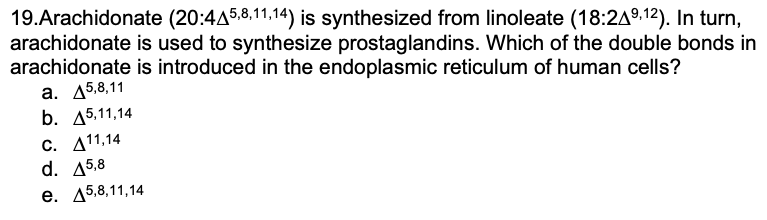

Transcribed Image Text:19.Arachidonate (20:4A5.8,11,14) is synthesized from linoleate (18:2A9,12). In turn,
arachidonate is used to synthesize prostaglandins. Which of the double bonds in
arachidonate is introduced in the endoplasmic reticulum of human cells?
а. Д5.8,11
b. Д5,11,14
С. Д11,14
d. Д5,8
е. Д5.8,11,14
Expert Solution

This question has been solved!
Explore an expertly crafted, step-by-step solution for a thorough understanding of key concepts.

This is a popular solution

Trending nowThis is a popular solution!

Step by stepSolved in 3 steps with 7 images

Knowledge Booster


Learn more about
Need a deep-dive on the concept behind this application? Look no further. Learn more about this topic, biochemistry and related others by exploring similar questions and additional content below.Similar questions
- Amoeboid cells that migrate through our tissues, such as the class of white blood cells known as neutrophils, often do so in a directed manner, triggered, for instance, by chemical signals released by pathogens such as bacteria. Directed migration in response to a chemical stimulus is known as chemotaxis. Part of an efficient chemotactic response is the ability of cells to polarize. As is the case with our structurally-polar polymers like F-actin or microtubules, polarization here refers to an asymmetry in the cells, rather than an electrical charge. In this case, it involves one part of the cell becoming the “front” (or leading edge) and another the rear. In a well-polarized, migrating cell, it’s been observed that an active form of Rac (which, in turn, can activate ARP 2/3) is concentrated towards the front of the cell, whereas an active form of Rho (which, in turn, can activate formin, inhibit cofilin/ADP, and activate myosin II) is found toward the rear of the cell. Based on your…arrow_forward2B. S. aureus hemolysin B attacks the RBC cell membrane by hydrolyzing the sphingomyelin headgroup: ОН HN .R hemolysin B cuts this bond i) Draw a plausible mechanism of hydrolysis for this lipid headgroup. Let B- and BH be general base and general acid. 00-P-O LOR2 OR, ii) Why is this damaging to the overall membrane architecture of the RBC?arrow_forward5arrow_forward
- 5. Anesthetic gases used in surgery are known to bind to the hemoglobin molecule in red blood cells. The diagram below illustrates O2 binding curves of normal human HbA in the presence of the anesthetic gas dichloromethane (DCM). O UNTREATED 100 a DCM 23 Tor • DCM 50 Torr x DCM 100 Torr Symbols: o, 0 Torr DCM; O, 23 Torr DCM A, 50 Torr DCM x, 100 Torr DCM. 80 40 (1 Torr = 1 mm Hg.) The solutions buffered to pH 7.4. 20 were 0.5 1.0 1.5 2.0 log po2 % OXYGENATIONarrow_forwardat punctures the bacterial cell wall has just been recently isolated from the F the peptide reveals the following information below: IOTE: when the sequence is nat knawn, a comma separates the amino acids) Hydrazine Acid Hydrolysis (6 N HCI) at 110 °C Heptapeptide (2) Arg, Pro, Phe, Tyr, Ala, Lys 2.4-dinitrofluorobenzene DNP-Phe Lys and modified free Peptide 1 (Ala, Lys) amino acids Cleovoge with Trypsin, then chromatography Peptide 2 (Pro, Arg, Tyr) Peptide 3 (Phe, Arg) Phe Cleavage with Chymotrypsin, then chromatography Peptide 4 (Arg, Tyr) Peptide 5 (Lys, Pro, Ala, Arg) When answering the questions below, please use the ONE-LETTER CODE for the amino acid, with NO spaces and symbols between each letter. 1. What is the C-terminal residue? K 2. What is the N-terminal residue? F 3. What is the sequence of Peptide 3? GP 4. What is the sequence of Peptide 5? LPAA 5. What is the averall amino acid sequence? ALarrow_forwardThe new E484K mutation in SARS-CoV Spike produces a) a change from a hydrophillic to a hydrophopic patch on the surface of Spike B. a change from hydrophobic to a hydrophilic patch in the buried interior of Spike c) a change in charge on the surface of Spike d) a change in charge in the buried interior of Spikearrow_forward
- Imidazole is used to elute His6-tagged proteins from Ni-NTA resins because imidazole is: a. More acidic b. Structurally similar to histidine c. More basic d. A compound that can change the pH in the bufferarrow_forwardTwo proteins are discovered, and both are shown to have a potential in treating fatty liver disease. The structural differences of the proteins require them to be delivered using spherical nanoparticles made of different polymers. The scientists are trying to decide which protein will be more efficient to use in applications where a faster drug release is more favorable. Protein 1 is loaded into spherical nanoparticles made of polymer 1 which has R=100 nm at a concentration of 50 nM. Protein 2 is loaded into spherical nanoparticles made of polymer 2 which has R=250 nm, at a concentration of 50 nM. The partition coefficient of polymer 1 is 0.01 and is known to be half of partition coefficient of polymer 2. The diffusion coefficient of protein 1 in polymer 1 is 2x10⁻⁶ cm2/s, and diffusion coefficient of protein 2 in polymer 2 is 3.4x10⁻⁶ cm2/s. Determine which treatment will be selected for treatment of fatty liver disease.arrow_forwardA. Which one of the following is an example of affinity chromatography? Select all that apply. a) Hormone – receptor interaction b) Enzyme – substrate interaction c) Antigen-antibody interaction d) All of the above e) Cytochrome C – DEAE matrix B. If your sepharose beads are covalently attached to adrenaline hormone, which of the following protein is most likely purified by affinity chromatography? a) Receptor tyrosine kinase (RTK) b) Calmodulin c) GPCR d) Protein kinase A C. Which of the following malate dehydrogenase (MDH) has a 'peptide epitope tag'? a) MDH-HA b) MDH-GST c) MDH-GFP e) All of them D. To elute target proteins from an affinity chromatography matrix, which of the following conditions would be the most appropriate? a) Low salt concentrations b) High salt concentrations c) Adding a soluble ligand that competes with the affinity tagged protein for binding to the column d) Just keep washing buffer through the column, isocratic elutionarrow_forward
- 1. A variety of organic chelating ligands have been synthesized to tightly coordinate radioactive metal cations to identify and treat malig- nancies by coupling the metal complex to a polypeptide linker attached to a monoclonal antibody that binds specifically to a cell surface re- ceptor. One such metal complex is illustrated in the diagram on the right. The radioactive Cu-64 cation is tightly coordinated by the che- lating ligand that is, in turn, conjugated to a peptide linker attached to a monoclonal antibody. (The antibody is not shown in this diagram.) When coupled to a specifically designed monoclonal antibody, the complex binds specifically to somatostatin receptors that are ex- pressed on the surface of neuroendocrine tumors. Subsequently the entire complex with the receptor is internalized, i.e., passed into the cytoplasm, where the radioactive metal cation kills the malignant cell. CH3 HN NHNH HN NHNH HN НО НО NH HN HN HO S-S NH (a) dues in the polypeptide. Place the label…arrow_forward2. The following tyrosine-phosphorylated polypeptides were tested as substrates of protein tyrosine phosphatase, an important enzyme in cellular signal transduction. The pTyr in bold signifies the tyrosine residue that is phosphorylated. The binding affinities of the polypeptide substrates to the enzyme were found to follow the order: (a) > (c) - (d) >> (b). (a) Asp-Ala-Asp-Glu-pTyr-Leu-lle-Pro-Gln-Gln-Gly (b) Pro-Val-Pro-Glu-pTyr-lle-Asn-Ala-Ser-Val (c) Asp-Ala-Glu-Glu-pTyr-Leu-Val-Pro-Gln-Gln-Gly (d) Asp-Asn-Leu-Tyr-pTyr-Trp-Asp-Glu-Asn-Ser-Ser In addition to the presence of the phosphorylated tyrosine residue, what amino acid a) properties of the polypeptides accounts for the relative order of binding affinities to the enzyme? b) the active site of the phosphatase enzyme that are responsible for the affinity of substrate binding? Assume a pH of 7.4 at the enzyme active site. (Note a phosphatase uses phosphate substrate) What amino acids have side chains that would indicate they are…arrow_forward25. Assume we are performing a 2x serial dilution series of methylene similar to WL-1. If your original, 1x tube is designated "Tube 1", then what would be the relative concentration of methylene blue in Tube 4? a. Tube 4 is the 8x dilution tube. The concentration of methylene blue in this tube is 1/8 that of the original tube. b. Tube 4 is the 8x dilution tube. The concentration of methylene blue in this tube is 8 times that of the original tube. c. Tube 4 is the 4x dilution tube. The concentration of methylene blue in this tube is 4 times that of the original tube. d. Tube 4 is the dilution 10x tube. The concentration of methylene blue in this tube is 1/10 that of the original tube. e. None of the abovearrow_forward
arrow_back_ios
SEE MORE QUESTIONS
arrow_forward_ios
Recommended textbooks for you
- BiochemistryBiochemistryISBN:9781319114671Author:Lubert Stryer, Jeremy M. Berg, John L. Tymoczko, Gregory J. Gatto Jr.Publisher:W. H. Freeman
 Lehninger Principles of BiochemistryBiochemistryISBN:9781464126116Author:David L. Nelson, Michael M. CoxPublisher:W. H. Freeman
 Fundamentals of Biochemistry: Life at the Molecul...BiochemistryISBN:9781118918401Author:Donald Voet, Judith G. Voet, Charlotte W. PrattPublisher:WILEY
  BiochemistryBiochemistryISBN:9781305961135Author:Mary K. Campbell, Shawn O. Farrell, Owen M. McDougalPublisher:Cengage Learning
 BiochemistryBiochemistryISBN:9781305577206Author:Reginald H. Garrett, Charles M. GrishamPublisher:Cengage Learning
 Fundamentals of General, Organic, and Biological ...BiochemistryISBN:9780134015187Author:John E. McMurry, David S. Ballantine, Carl A. Hoeger, Virginia E. PetersonPublisher:PEARSON
Biochemistry
Biochemistry
ISBN:9781319114671
Author:Lubert Stryer, Jeremy M. Berg, John L. Tymoczko, Gregory J. Gatto Jr.
Publisher:W. H. Freeman
Lehninger Principles of Biochemistry
Biochemistry
ISBN:9781464126116
Author:David L. Nelson, Michael M. Cox
Publisher:W. H. Freeman
Fundamentals of Biochemistry: Life at the Molecul...
Biochemistry
ISBN:9781118918401
Author:Donald Voet, Judith G. Voet, Charlotte W. Pratt
Publisher:WILEY
Biochemistry
Biochemistry
ISBN:9781305961135
Author:Mary K. Campbell, Shawn O. Farrell, Owen M. McDougal
Publisher:Cengage Learning
Biochemistry
Biochemistry
ISBN:9781305577206
Author:Reginald H. Garrett, Charles M. Grisham
Publisher:Cengage Learning
Fundamentals of General, Organic, and Biological ...
Biochemistry
ISBN:9780134015187
Author:John E. McMurry, David S. Ballantine, Carl A. Hoeger, Virginia E. Peterson
Publisher:PEARSON