
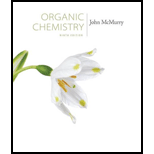
Organic Chemistry
9th Edition
ISBN: 9781305080485
Author: John E. McMurry
Publisher: Cengage Learning
expand_more
expand_more
format_list_bulleted

Concept explainers

Videos
Question

Chapter 1.7, Problem 8P
Expert Solution & Answer


Trending nowThis is a popular solution!

Students have asked these similar questions
Skip
Which type of polymerization involves opening of a ring structure?A. Addition polymerizationB. Condensation polymerizationC. Ring-opening polymerizationD. Copolymerization
Which of the following shows cis-trans isomerism?A. CH3CH2OHB. CH3CH=CHCH3C. CH4D. CCl4
can you draw how is it for aleks
Chapter 1 Solutions
Organic Chemistry
Chapter 1.3, Problem 1PChapter 1.3, Problem 2PChapter 1.4, Problem 3PChapter 1.4, Problem 4PChapter 1.4, Problem 5PChapter 1.4, Problem 6PChapter 1.4, Problem 7PChapter 1.7, Problem 8PChapter 1.7, Problem 9PChapter 1.8, Problem 10P
Chapter 1.8, Problem 11PChapter 1.8, Problem 12PChapter 1.9, Problem 13PChapter 1.10, Problem 14PChapter 1.12, Problem 15PChapter 1.12, Problem 16PChapter 1.12, Problem 17PChapter 1.SE, Problem 18VCChapter 1.SE, Problem 19VCChapter 1.SE, Problem 20VCChapter 1.SE, Problem 21VCChapter 1.SE, Problem 22APChapter 1.SE, Problem 23APChapter 1.SE, Problem 24APChapter 1.SE, Problem 25APChapter 1.SE, Problem 26APChapter 1.SE, Problem 27APChapter 1.SE, Problem 28APChapter 1.SE, Problem 29APChapter 1.SE, Problem 30APChapter 1.SE, Problem 31APChapter 1.SE, Problem 32APChapter 1.SE, Problem 33APChapter 1.SE, Problem 34APChapter 1.SE, Problem 35APChapter 1.SE, Problem 36APChapter 1.SE, Problem 37APChapter 1.SE, Problem 38APChapter 1.SE, Problem 39APChapter 1.SE, Problem 40APChapter 1.SE, Problem 41APChapter 1.SE, Problem 42APChapter 1.SE, Problem 43APChapter 1.SE, Problem 44APChapter 1.SE, Problem 45APChapter 1.SE, Problem 46APChapter 1.SE, Problem 47APChapter 1.SE, Problem 48APChapter 1.SE, Problem 49APChapter 1.SE, Problem 50APChapter 1.SE, Problem 51APChapter 1.SE, Problem 52APChapter 1.SE, Problem 53APChapter 1.SE, Problem 54APChapter 1.SE, Problem 55APChapter 1.SE, Problem 56APChapter 1.SE, Problem 57AP
Knowledge Booster


Learn more about
Need a deep-dive on the concept behind this application? Look no further. Learn more about this topic, chemistry and related others by exploring similar questions and additional content below.Similar questions
- Draw the missing organic structures or select the missing reagents in the following multistep synthesis. Ignore any inorganic byproducts formed. OH Br 00 [P I Select to Draw + 1) PPh3 2) nBuLi Select to Drawarrow_forwardDraw the major product of this reaction. Ignore inorganic byproducts. 1. CH3CCMgBr 2. H3O+ Drawingarrow_forwardDraw the starting molecule to produce this ester when treated with mCPBA. Drawing MCPBA Qarrow_forward
- Draw the major product of this reaction. Ignore inorganic byproducts. MCPBA Drawing Qarrow_forward+ Draw the starting reactant that would produce this hydrazone when treated with this reagent. Ignore inorganic byproducts. N' .NH Drawing PhNHNH2, TSOH @arrow_forwardDraw the skeletal (bond-line) structure of (R)-3- fluoro-3-methylhexanal. Use a dash or wedge bond to indicate stereochemistry of substituents on asymmetric centers, where applicable. Drawingarrow_forward
- Provide the correct IUPAC name for the compound shown here. Reset H 2,4,6- 4- 7- 2- 3,4,7- 3- tri di cyclo tert- iso sec- pent hept eth oct hex meth oate al an one ol ylarrow_forwardProvide the correct IUPAC name for the compound shown here. CH3 H-C-CH-CH-CH2-CH2-CH2-CH3 “ཡརི་ཡ་ལོ་ཡ86- CI 7- 2-4-3-5-6- iso tri sec- cyclo di tert- meth hex hept chloro but carboxy Reset an ol al oate yl onearrow_forwardThe gas used in the Haber process is:A) OxygenB) NitrogenC) ChlorineD) Carbon dioxidearrow_forward
arrow_back_ios
SEE MORE QUESTIONS
arrow_forward_ios
Recommended textbooks for you
 Chemistry: The Molecular ScienceChemistryISBN:9781285199047Author:John W. Moore, Conrad L. StanitskiPublisher:Cengage Learning
 Chemistry: Principles and PracticeChemistryISBN:9780534420123Author:Daniel L. Reger, Scott R. Goode, David W. Ball, Edward MercerPublisher:Cengage Learning
 Introductory Chemistry: An Active Learning Approa...ChemistryISBN:9781305079250Author:Mark S. Cracolice, Ed PetersPublisher:Cengage Learning
 Chemistry by OpenStax (2015-05-04)ChemistryISBN:9781938168390Author:Klaus Theopold, Richard H Langley, Paul Flowers, William R. Robinson, Mark BlaserPublisher:OpenStax
 Chemistry: Principles and ReactionsChemistryISBN:9781305079373Author:William L. Masterton, Cecile N. HurleyPublisher:Cengage Learning
 Organic ChemistryChemistryISBN:9781305580350Author:William H. Brown, Brent L. Iverson, Eric Anslyn, Christopher S. FootePublisher:Cengage Learning
Chemistry: The Molecular Science
Chemistry
ISBN:9781285199047
Author:John W. Moore, Conrad L. Stanitski
Publisher:Cengage Learning
Chemistry: Principles and Practice
Chemistry
ISBN:9780534420123
Author:Daniel L. Reger, Scott R. Goode, David W. Ball, Edward Mercer
Publisher:Cengage Learning
Introductory Chemistry: An Active Learning Approa...
Chemistry
ISBN:9781305079250
Author:Mark S. Cracolice, Ed Peters
Publisher:Cengage Learning
Chemistry by OpenStax (2015-05-04)
Chemistry
ISBN:9781938168390
Author:Klaus Theopold, Richard H Langley, Paul Flowers, William R. Robinson, Mark Blaser
Publisher:OpenStax
Chemistry: Principles and Reactions
Chemistry
ISBN:9781305079373
Author:William L. Masterton, Cecile N. Hurley
Publisher:Cengage Learning
Organic Chemistry
Chemistry
ISBN:9781305580350
Author:William H. Brown, Brent L. Iverson, Eric Anslyn, Christopher S. Foote
Publisher:Cengage Learning
Stoichiometry - Chemistry for Massive Creatures: Crash Course Chemistry #6; Author: Crash Course;https://www.youtube.com/watch?v=UL1jmJaUkaQ;License: Standard YouTube License, CC-BY
Bonding (Ionic, Covalent & Metallic) - GCSE Chemistry; Author: Science Shorts;https://www.youtube.com/watch?v=p9MA6Od-zBA;License: Standard YouTube License, CC-BY
General Chemistry 1A. Lecture 12. Two Theories of Bonding.; Author: UCI Open;https://www.youtube.com/watch?v=dLTlL9Z1bh0;License: CC-BY